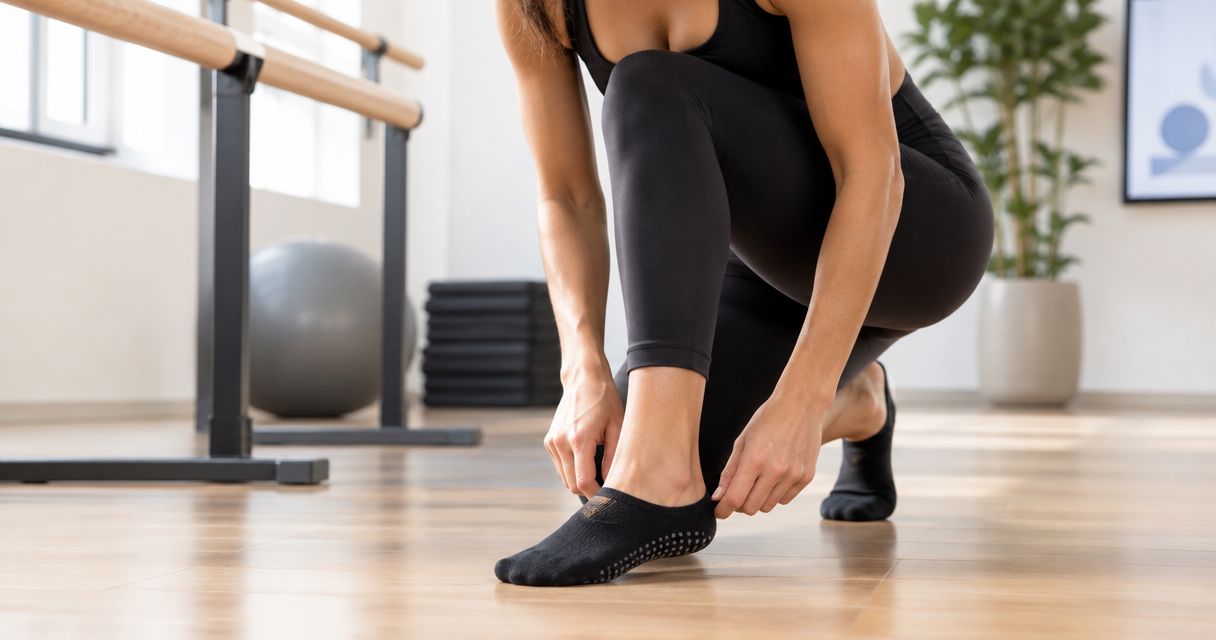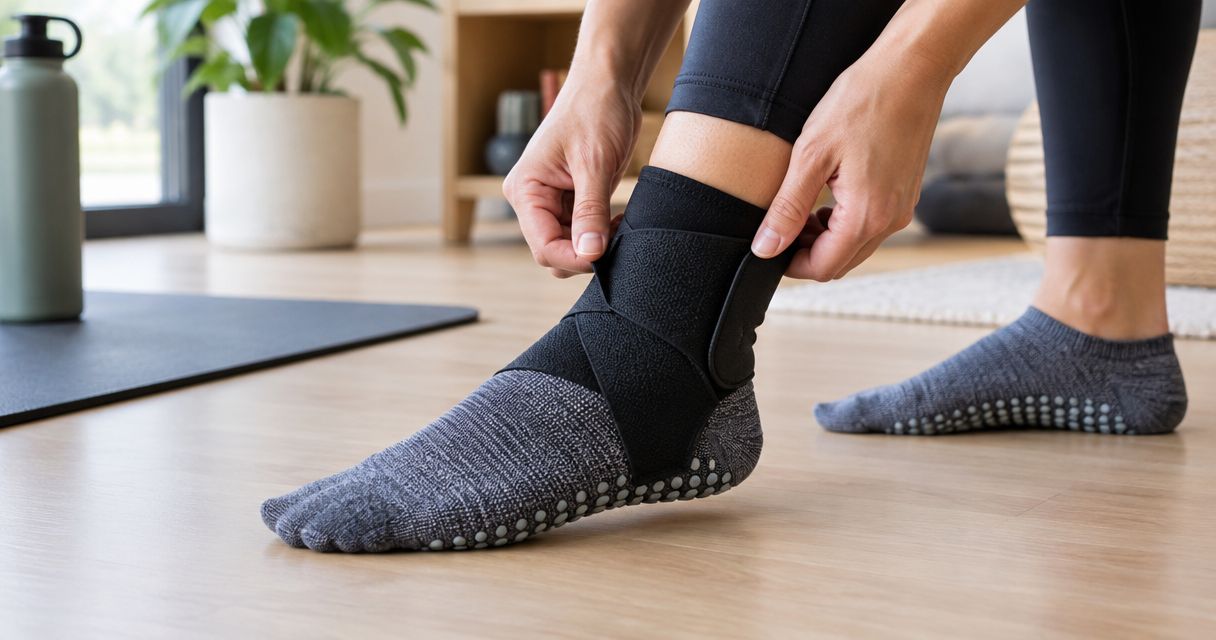
Yes, you can wear grip socks with an ankle brace when the brace’s instructions allow that sock layer, the brace fits correctly, and the grippy sole remains exposed. Grip socks do not replace ankle support or clearance to exercise, and a brace that covers the sock’s sole prevents those covered grips from contacting the floor or equipment.
- Can you wear grip socks with an ankle brace? Yes, when brace instructions permit the combination and fit stays comfortable.
- California Grip Socks makes studio socks, not a replacement for a prescribed ankle brace.
- Covered grips cannot contact the floor; check the brace’s underside before relying on traction.
- For Pilates or barre, confirm exercise clearance separately from whether the sock and brace fit together.
Can you wear grip socks with an ankle brace?
The brace’s wearing instructions decide the layering order—not the sock style. If those instructions specify a sock underneath, choose a sock that meets their requirements. Do not assume a grip sock is suitable just because it fits inside the brace.
For this 2026 guide, the useful distinction is between an exposed grippy sole and a sole covered by brace material. Sock height matters too, but an ankle-length style is not automatically brace-compatible. The ankle grip socks guide covers that sock category; your brace instructions still determine what belongs underneath it.
| Brace or support option | Best for | Potential advantage with socks | Limitation to check |
|---|---|---|---|
| Soft ankle support | People instructed to use that specific support | Some designs leave much of the sock sole exposed | An underfoot section can cover the grips; fabric can also bunch |
| Lace-up or strapped ankle brace | People prescribed or advised to use that brace | Adjustable closures allow the brace to be fitted as directed | Added sock bulk can change closure fit; straps can cover the sole |
| Rigid ankle brace | People whose care plan calls for rigid support | Provides the support specified by the treating clinician | Hard edges, liners, and underfoot pieces need device-specific checks |
| Walking boot | People instructed to wear a boot | A sock can serve as the instructed layer inside the boot | The boot’s outsole—not the sock’s grips—contacts the walking surface |
These are fit considerations, not a ranking of braces. Choose the support your clinician recommends for your situation, rather than the option that shows off more of your socks.
Why this matters
Grip socks and ankle braces have 2 separate jobs: grip socks provide a grippy contact surface, while an ankle brace provides the support its design is intended to deliver. Combining them does not turn the sock into medical support or make a workout appropriate for an injured ankle.
That distinction matters when you are getting ready for class. A combination that feels comfortable while seated is not proof that you can do standing barre work, load a reformer footbar, or move through a yoga flow.
Use this 2026 checklist to separate the questions: does the brace fit, do the grips contact the surface, and are you cleared for the activity? You need an answer to each. A cute pair is the easy part.
Soft ankle supports: check the fabric beneath your foot
A soft support can look sock-friendly because it has no obvious hard shell. Still, check its entire shape. Some supports include fabric beneath the arch or heel, and that material sits between your grip sock and the floor.
Best for: people whose clinician or device instructions call for that particular support. The practical upside is that an open design can leave areas of the grippy sole uncovered; the downside is that an underfoot band interrupts that contact.
Follow the specified placement against your skin or over a sock. Do not reverse the layering order to expose more grips. If the support calls for direct skin contact, ask the clinician or manufacturer whether a grip sock can be used alongside it without changing that placement.
Also check the cuff. A sock edge tucked into a tight support can fold rather than lie flat, so smooth the fabric before fastening anything.
Lace-up ankle braces: check closures and underfoot straps
A lace-up brace needs the correct fit with whatever sock layer its instructions permit. Start with the specified fitting sequence, including the order of laces and straps. Do not compensate for extra sock bulk by improvising the tension.
Best for: people instructed to wear a lace-up brace. Adjustable closures are useful for fitting the device as directed, but they are not permission to add extra layers or tighten through discomfort.
Look underneath your foot once the brace is fitted. A strap that crosses the sole can cover part of the grip pattern even when the heel and toes remain visible. Visible grips in one area do not prove the whole setup has reliable traction.
Keep the brace’s required positioning intact. If a strap covers a contact area you need for class, ask about an appropriate modification to the activity—not a modification to the brace.
Rigid braces and walking boots: follow the device instructions
A rigid brace can include a liner, hard edges, or a section beneath the foot. Each affects how a sock sits inside the device. There is no universal rule that a thin, tall, or ankle-length grip sock works with every rigid brace.
Best for: people whose care plan specifies the device. The benefit is using the prescribed support; the trade-off is that sock choice must fit around the device’s requirements rather than your outfit preferences.
Inside a walking boot, the sock’s grippy sole does not contact the floor. The boot’s outsole does. Wearing grip socks inside the boot therefore does not provide the same floor-contact function as wearing them uncovered in a studio.
Do not remove a prescribed boot for class just to use grip socks. Ask the treating clinician what exercise is appropriate and whether the boot must remain on during that activity.
Why grip sock and ankle brace fit varies
No single sock-and-brace pairing works for everyone. These are the details to check before choosing your setup in 2026:
- Layering instructions: the device can specify direct skin contact, a sock underneath, or a particular liner. Follow that requirement first.
- Underfoot coverage: fabric, straps, or a rigid foot section can sit over the grip pattern and block contact with the surface.
- Sock bulk: thicker fabric, cushioning, seams, and folds change the space occupied inside a fitted brace.
- Cuff position: a cuff that ends beneath a brace edge needs a different fit check from one that extends above it.
- Your care plan: swelling, skin sensitivity, and restrictions on movement affect what is appropriate for your ankle.
- Class requirements: a studio’s sock rule does not override a clinician’s instructions or the brace manufacturer’s fitting directions.
Check these details with the actual brace you use. A recommendation for another person’s support is not a compatibility test for yours.
How do you check the sock and brace before class?
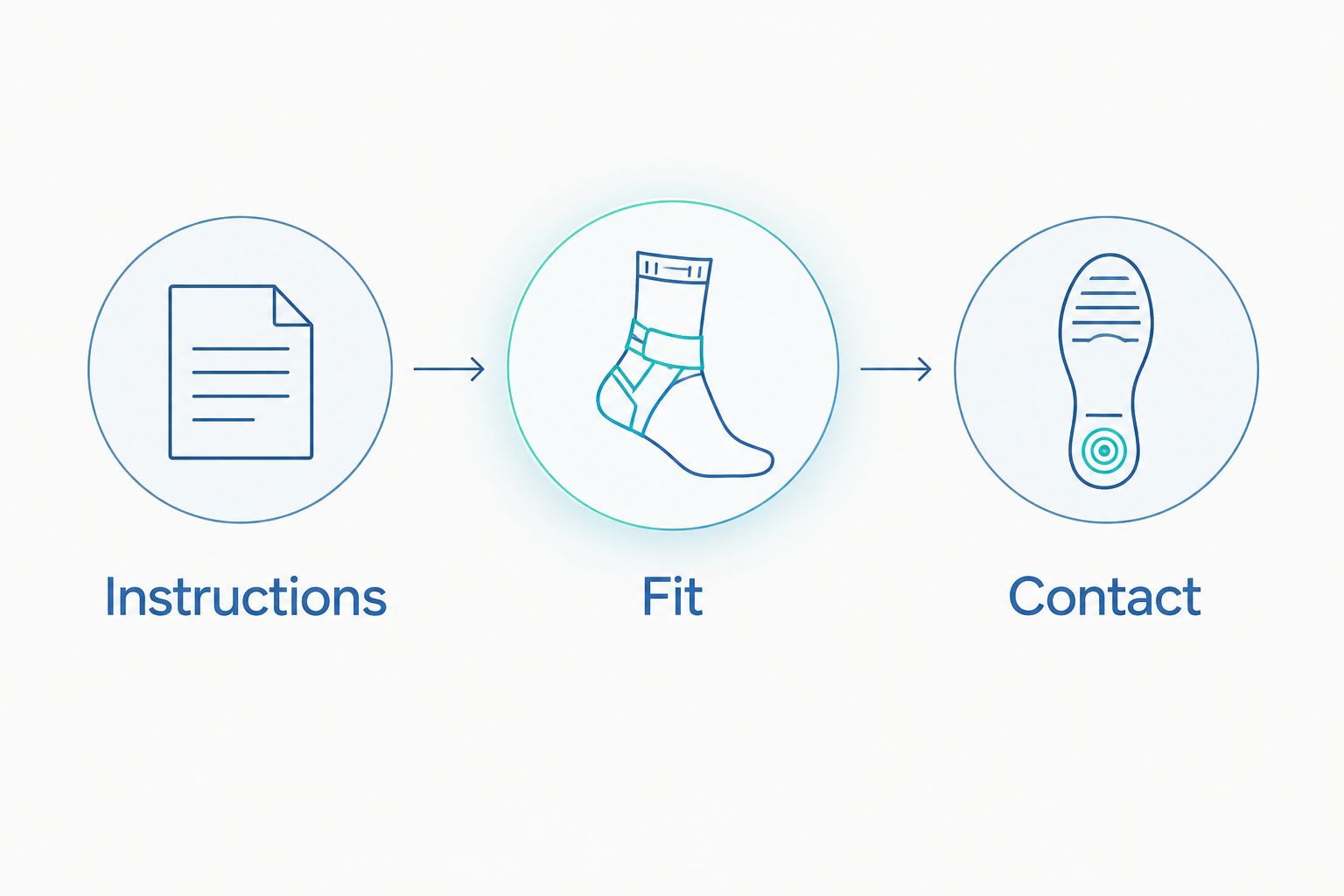
Use 3 checks: instructions, fit, and contact. This is a preparation checklist, not a test of whether an injury has healed.
- Instructions: read the brace’s wearing directions and follow your clinician’s advice about socks, footwear, and permitted activity. If they conflict with a studio requirement, resolve that before attending.
- Fit: put on the allowed sock layer, smooth the fabric, and fit the brace in the instructed order. Check for folded seams, a trapped cuff, discomfort, or a closure that no longer fits as directed.
- Contact: inspect the underside of your foot. Identify where the sock grips remain exposed and where the brace covers them. Do not count covered grips as floor contact.
Keep those checks separate. Comfortable fit does not establish traction, and traction does not establish exercise clearance.
If you are cleared to exercise, let the instructor know about your brace and any restrictions before class starts. Ask about equipment contact and permitted modifications rather than trying a challenging movement to see whether the setup holds.
What should you look for in a grip sock?
Choose around the brace requirements first, then your preferred sock style. Look for a fit that stays smooth in the permitted wearing position, with no bunching beneath straps or edges. The cuff should sit where it will not interfere with the device’s intended fit.
An ankle-length sock leaves less fabric above the ankle, but it also provides less coverage beneath a taller brace. A longer sock offers more coverage, but its cuff or fabric can still interfere with closures. Neither length is automatically the winner.
California Grip Socks is best for Pilates, Lagree, yoga, and barre practitioners who want cute grip socks—not medical ankle support. California Grip Socks designs socks for wear in and out of the studio; the supplied product information does not establish compatibility with any particular ankle brace.
For your 2026 class bag, the right purchase decision is a sock that meets your brace’s requirements. Color and print come after that check. Do not treat a studio sock description as a medical-device fitting guide.
Can you wear grip socks over an ankle brace?
Do not pull grip socks over an ankle brace unless the device instructions or your clinician specifically approve that arrangement. A sock stretched over straps or a rigid shape is not the same fit as a sock worn on your foot.
The outer sock can hide closures and make the brace harder to inspect. It can also sit differently from its intended position, so exposed grip dots alone do not establish that the arrangement is suitable.
If your aim is to keep the grips visible, first check whether the prescribed brace leaves the sole exposed when worn correctly. If it does not, ask about suitable footwear or activity changes rather than covering the brace with a sock.
Can you do Pilates or barre while wearing an ankle brace?
Only do the activity your treating clinician has cleared, with the brace worn as directed. Being able to fit grip socks beneath an ankle brace does not establish that Pilates, barre, yoga, or Lagree is appropriate for your ankle.
Tell the instructor about any limits on weight-bearing or ankle movement. A studio class is not a substitute for an individual rehabilitation plan, and an instructor should not change your prescribed support to make an exercise easier to perform.
The grip socks for physical therapy and rehab guide covers a related setting. For your own session, bring the exact brace and socks you intend to use so your clinician can assess the combination directly.
What if the brace feels tighter with grip socks?
Stop and check the fit rather than tightening through discomfort. Added fabric changes what sits beneath the brace, even when the sock looks slim. Smooth out folds and follow the device’s fitting directions again.
New pain, numbness, tingling, or skin irritation warrants stopping the activity and getting advice about the fit. Seek urgent medical assessment for a cold, pale, or blue foot or toes, especially with pain or loss of sensation.
Do not size up the brace, cut a sock, remove a liner, or change prescribed strap placement on your own. Ask the clinician or device supplier how to resolve the problem while keeping the required support.
FAQ
Can you wear grip socks with an ankle brace in 2026?
Yes, when the brace instructions permit the sock layer, the brace fits correctly, and the grips needed for surface contact remain exposed. Exercise clearance is a separate decision for your treating clinician.
Should grip socks go under or over an ankle brace?
Follow the brace’s specified layering order. Do not assume grip socks belong underneath every brace, and do not pull them over the device without approval from its instructions or your clinician.
Are ankle grip socks better than crew socks with a brace?
Neither length is automatically better with an ankle brace. Choose the coverage and fit required by the device, checking that cuffs, seams, and fabric do not interfere with its placement.
Do grip socks still work if brace straps cover the bottom?
Covered grip areas cannot contact the floor or equipment. Any uncovered areas must be assessed separately; do not assume partial exposure gives the whole setup reliable traction.
Can I wear grip socks inside a walking boot?
Use only a sock that meets the walking boot’s instructions and your clinician’s advice. Inside the boot, the sock grips do not contact the floor; the boot’s outsole does.
Can California Grip Socks replace an ankle brace for Pilates?
No, California Grip Socks cannot replace a prescribed ankle brace. Studio grip socks and medical ankle support serve different purposes, and socks do not provide clearance to exercise.
What should I do if my toes tingle after putting on the brace?
Stop exercising and address the fit with your clinician or device supplier. A cold, pale, or blue foot or toes, especially with pain or loss of sensation, needs urgent medical assessment.
One last thing
Show your clinician the underside of the setup, not just the front of your ankle. That is where a strap, liner, or brace section can cover the grip pattern without being obvious from above.
Before your next class in 2026, bring the socks, brace, and any required footwear together. Ask about the complete setup and the actual activity you plan to do. Fit first. Cute second.