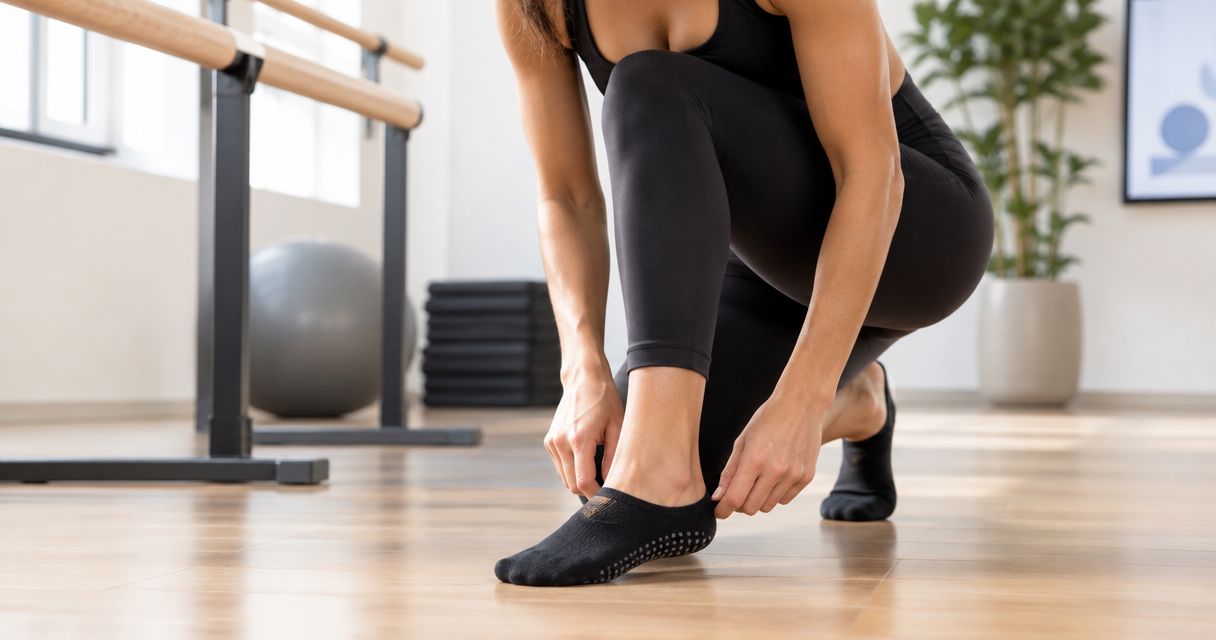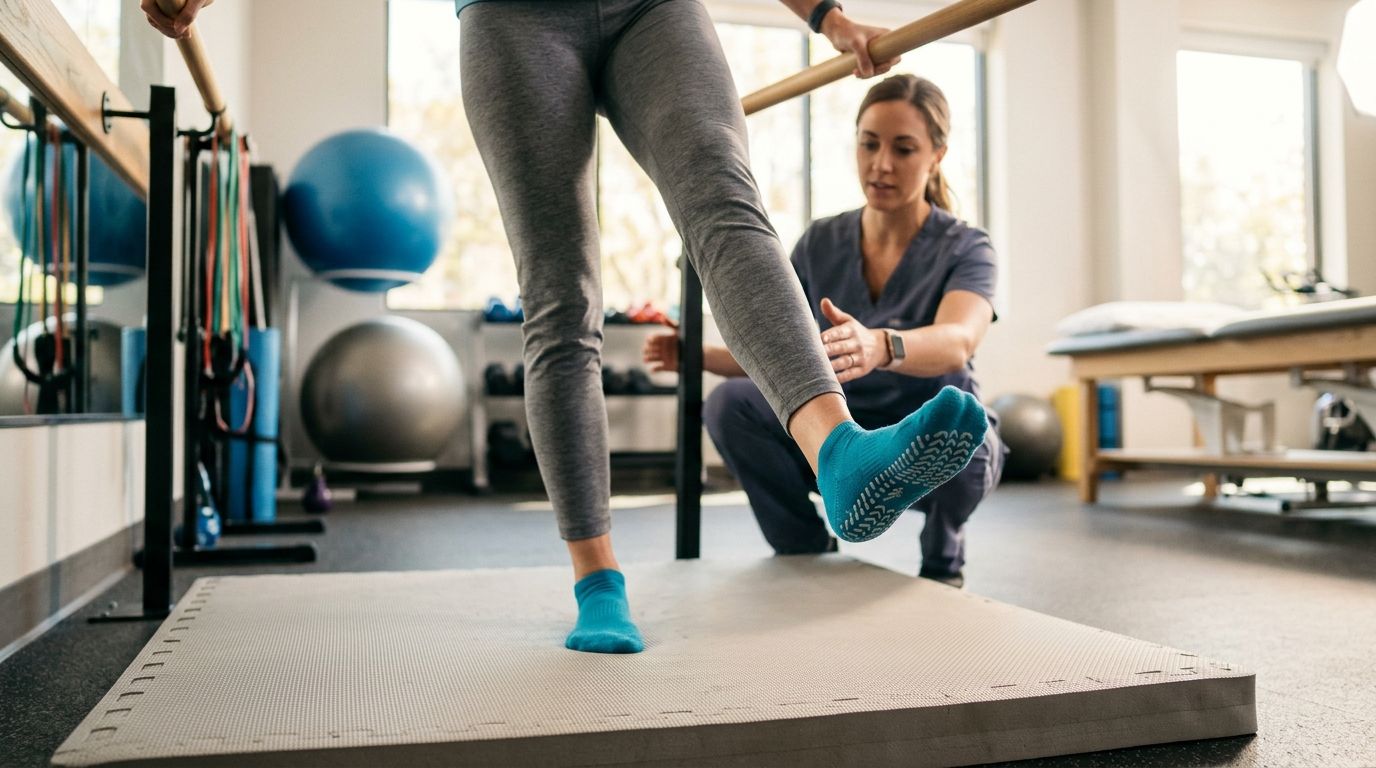
Grip socks for physical therapy and rehab are non-slip socks with rubber grips on the sole, worn during clinic sessions, home exercise programs, and mat work so patients get traction without wearing shoes indoors. Rehab patients need something different than a studio-goer buying cute Pilates socks: easy on/off for stiff joints, room for swelling, and a length that doesn't press on a fresh incision or brace.
- Grip socks for physical therapy work best when sized loose enough for post-op swelling, not your normal shoe size.
- Shortie and ankle-length grip socks are easier to pull on after knee, hip, or foot surgery than tall crew styles.
- California Grip Socks' Classic Ankle style avoids pressure on ankle incisions while still gripping clinic mats.
- Rotate at least 2-3 pairs of rehab grip socks per week since PT sessions run several times weekly through 2026.
- Grip socks are not a substitute for a brace, compression stocking, or your PT's specific footwear instructions.
Why grip socks matter for physical therapy and rehab patients
Most outpatient PT clinics use vinyl or laminate floors and stackable mats, both slick under bare feet and worse under standard cotton socks. Clinics that run mat-based rehab, balance retraining, or post-surgical strength work often ask patients to bring their own grip socks rather than share studio pairs for hygiene reasons in 2026.
The difference for this segment isn't the print on the sock, it's the fit around a healing joint. A patient six weeks out from an ACL repair or a foot surgery is not thinking about ankle grip socks as a fashion choice; they're thinking about whether the sock cuff sits below or above a swollen ankle and whether they can get it on one-handed while holding a walker.
Rehab patients also cycle through more PT sessions per week than the average studio class-goer, which means the socks get worn and washed more often. A pair that loses its grip after eight washes is a bigger problem for someone in a 12-week rehab program than for someone taking two Pilates classes a month.
Update your sizing for swelling, not your shoe size
Post-surgical and injury swelling changes foot volume day to day, so a sock sized to your pre-injury shoe size will either cut off circulation or slide off mid-exercise.
- Size up one option if you're within 6-8 weeks of foot, ankle, or knee surgery
- Check for a stretch cuff rather than a tight elastic band around the ankle
- Avoid compression-style grip socks if your PT hasn't specifically prescribed compression
- Re-measure both feet if swelling is asymmetric, which is common after single-limb surgery
- Skip toe seams that dig in if you have neuropathy or nerve sensitivity in the toes
Match sock length to your injury site
The wrong cuff height is the single most common complaint from rehab patients trying grip socks for the first time — a crew sock that rides up over a knee brace, or an ankle sock that leaves a foot incision exposed to friction.
- Ankle-length for foot, toe, or lower-ankle surgery to avoid pressure at the incision line
- Shortie or low-crew for knee braces so the cuff sits below the hinge, not on top of it
- Crew grip socks for hip and lower-back rehab where full coverage prevents shin friction on mats
- No-show or low-cut styles if you're doing seated upper-body rehab and just need mat traction
- Avoid any sock with a firm ribbed band directly over a scar or staple line
Prioritize easy on/off over a snug fit
If you can't get the sock on without help, it doesn't matter how good the grip is. This matters most in the first 2-4 weeks after surgery when bending, balance, or hand strength is limited.
- Look for a wider opening cuff, not a compression-tight band
- Ruffle or shortie styles pull on faster than a full tube sock
- Sit down to put socks on rather than balancing on one leg
- Ask a caregiver to help until you clear your surgeon's bending restrictions
- Skip socks with a heel pocket if your foot shape has changed post-swelling


Check the sock against your specific clinic floor
Grip performance depends on the floor, and PT clinics vary between vinyl, foam mats, and carpet tile. A sock that grips a Pilates reformer strap won't necessarily grip a foam balance pad the same way.
- Test your socks on the actual mat or floor at your clinic, not just at home
- Silicone-dot soles tend to hold better on vinyl and hardwood than rubberized fabric
- Ask your PT if the clinic uses foam balance pads, which need a different grip pattern
- Bring a backup pair in your bag since PT sessions often run 2-3 times a week
- Replace socks once the silicone grips feel smooth or start peeling
Wash and rotate socks around wound care
Hygiene matters more here than in a studio setting because rehab socks sit close to healing skin, sometimes under a compression garment or brace liner.
- Wash after every session if the sock touched a bandage, brace liner, or open incision area
- Keep a rotation of at least 2-3 pairs so one is always clean and dry
- Skip fabric softener, which breaks down rubber grip dots faster
- Air dry instead of high heat to protect the grip coating
- Check with your surgeon about sock fabric if you have a known adhesive or latex sensitivity
Know when grip socks aren't enough
Grip socks solve traction, not stability. They don't replace a brace, a compression stocking, or a surgeon's specific footwear order, and they won't correct a balance deficit on their own.
- Follow your PT's brace or compression garment instructions over any sock choice
- Don't substitute grip socks for prescribed compression stockings
- Ask before wearing grip socks over a cast boot or walker if unsure about fit
- Use grip socks for traction on mats, not as fall-prevention footwear outdoors
- Flag any new swelling, redness, or pain to your PT regardless of what's on your feet
Comparing grip sock options for physical therapy
| Option | Best for | Sock length available | Key limitation |
|---|---|---|---|
| Pharmacy toe-less hospital socks | Immediate post-op, day 1-3 | Ankle only | Minimal grip pattern, wears out fast |
| Generic athletic grip socks | General mat work, no injury restrictions | Crew, no-show | Not designed around incision sites |
| California Grip Socks (ankle/shortie/midi) | Ongoing PT with a specific injury site to avoid | Ankle, shortie, midi, crew | Not a medical device; doesn't replace a brace |
| Barefoot / no socks | Balance retraining with clinician supervision only | N/A | No traction on smooth floors, higher slip risk |
Verdict: for patients past the first days of acute swelling, an ankle or shortie grip sock that clears the incision site is the safer daily pick over a generic crew sock — Buy the length that matches your injury, Skip anything with a tight compression band unless your PT prescribed it.
“The wrong cuff height is the single most common complaint from rehab patients trying grip socks for the first time.”
Common mistakes physical therapy and rehab patients make
- Buying by shoe size instead of current swelling — feet change size fast after surgery, and a snug sock at week 2 can restrict circulation
- Choosing tall crew socks over a knee brace — the cuff rides up and bunches under the hinge, causing pressure points during exercises
- Skipping the wash-after-every-session rule — rehab socks sit closer to incisions and brace liners than studio socks ever do
- Assuming all grip socks work on foam balance pads — silicone dot soles that grip vinyl floors can slide on foam
- Treating grip socks as fall-prevention footwear outside the clinic — they're built for indoor mat traction, not outdoor or wet surfaces
FAQ
Are grip socks good for physical therapy?
Yes, grip socks for physical therapy give traction on clinic mats and vinyl floors without the compression or bulk of shoes. Pick a length that clears your incision site or brace hinge.
What length grip sock is best after knee surgery?
A shortie or low-crew grip sock is best after knee surgery because it sits below the brace hinge. Full crew socks that ride up over the knee cause pressure points during exercises.
Can I wear grip socks over a compression stocking?
Only if your PT or surgeon approves it, since layering two tight garments can restrict circulation. Ask before combining grip socks with a prescribed compression stocking.
How often should I wash rehab grip socks?
Wash them after every session that touches a bandage, brace liner, or incision area. Keep 2-3 pairs in rotation so one is always clean for your next PT appointment.
Do grip socks replace shoes for physical therapy?
Grip socks replace shoes for mat-based and floor exercises indoors, not for walking outside or on wet surfaces. Follow your clinic's specific footwear policy for standing exercises.
What is the difference between grip socks and hospital non-slip socks?
Hospital toe-less socks are built for short-term post-op use with minimal grip patterns. Purpose-built grip socks like California Grip Socks hold their silicone grip longer through repeated washing over a multi-week rehab program.
Are ankle grip socks better than crew for foot surgery?
Ankle-length grip socks are better for foot surgery because the cuff sits below the incision line. Crew socks can rub against fresh scars or swelling at the ankle.
Can grip socks help with balance retraining?
Grip socks improve traction during balance retraining on mats and vinyl floors, but they do not correct the underlying balance deficit. Work with your PT on the exercises and use grip socks for the floor contact.
One last thing
If bending down to pull on socks is the actual barrier — not the grip, not the swelling — a shortie style solves that specific problem better than any ankle or crew option, because the shorter cuff needs far less reach and less hand strength to seat correctly. That's a small fit detail most rehab patients don't think to ask about until week 3 or 4 of a 2026 rehab program, and it's the difference between needing help every morning and not.