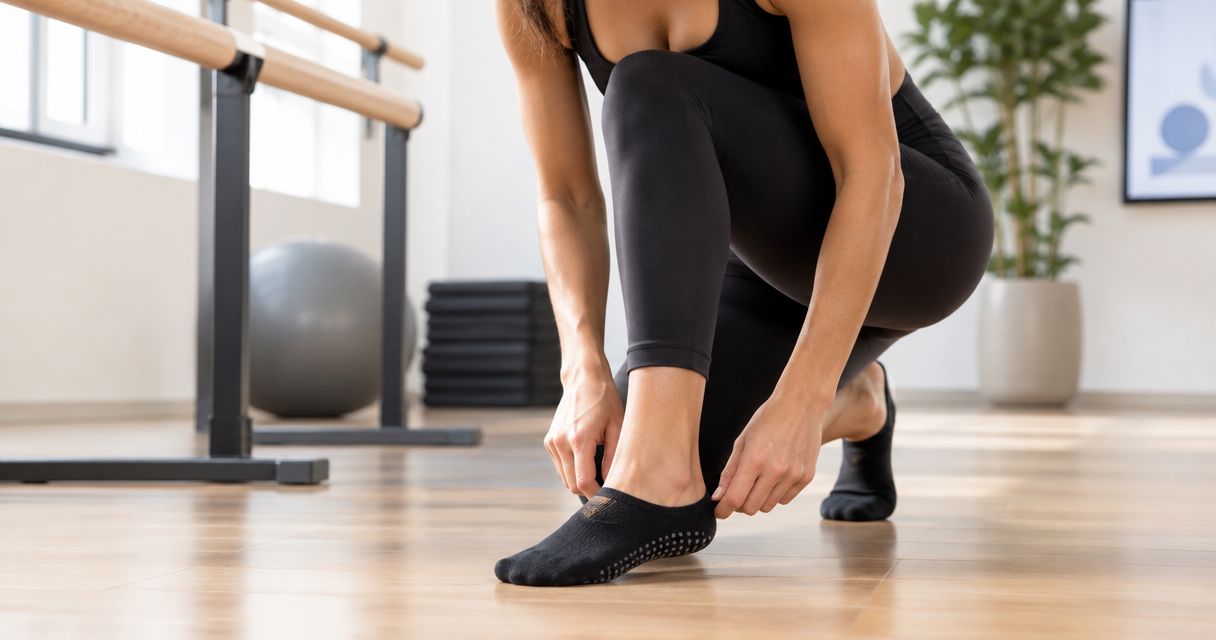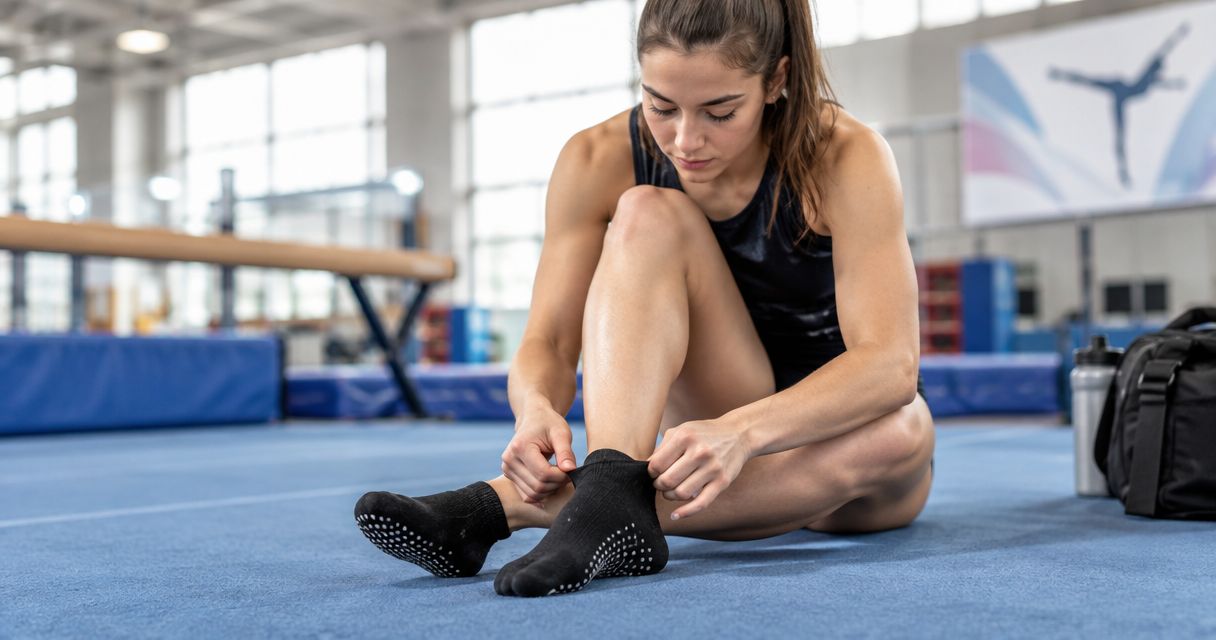
Gymnastics and cheer training grip socks are textured-sole socks used during coach-approved floor exercises, with the aim of limiting sock-on-surface sliding during conditioning and stretching. This 2026 guide explains where they fit, where they do not, and how athletes can assess California Grip Socks without treating a studio sock as gymnastics equipment.
- Grip socks for gymnastics fit coach-approved conditioning, stretching, and dance basics — not tumbling, apparatus work, or full stunts.
- California Grip Socks is best considered for low-impact floor drills because its stated design focus is Pilates, Lagree, yoga, and barre.
- Test grip socks on the actual practice surface before using them throughout a 2026 training session.
- Choose ankle, shortie, midi, or crew length according to fit, movement, and coach rules.
- Use bare feet, training shoes, chalk, or hand grips when the coach and discipline require them.
Why grip socks matter for gymnastics and cheer athletes
Gymnastics and cheer athletes do not train on one consistent surface. Conditioning can happen on a mat, dance basics can move to a studio floor, and sport-specific skills can require spring floors, beams, bars, turf, or coach-approved shoes. Traction that feels secure in one area does not automatically work in another.
Grip patterns create contact between the sock and the surface beneath it. They do not stop the foot from moving inside a loose sock, and they do not replace sport-specific equipment. Fit, surface texture, drill type, and coaching rules all decide whether grip socks belong in a 2026 session.
California Grip Socks are explicitly designed for Pilates, Lagree, yoga, and barre practitioners. Those activities overlap with gymnastics and cheer only during selected floor-based exercises, such as stretching and controlled conditioning. The practical rule is simple: use grip socks only where the coach allows socks and where the drill does not depend on direct barefoot contact, shoes, chalk, or hand grips.
How to choose grip socks for gymnastics and cheer training
Start with the free checks: ask the coach, inspect the practice surface, and try the drill slowly. Product selection comes later because no grip pattern can correct a rule conflict or poor fit.
Confirm the coach's footwear rules
Ask before packing grip socks for practice. A gym can permit socks during stretching but require bare feet for tumbling and beam work. A cheer program can allow them during mobility exercises while requiring training shoes for jumps, stunts, and full routines.
Get drill-specific guidance rather than asking whether socks are generally allowed. The answer changes across a single practice, and the coach controls progressions involving equipment, partners, height, or speed.
- Ask which conditioning drills permit socks
- Confirm whether dance basics require bare feet, socks, or shoes
- Remove grip socks before any skill the coach identifies as barefoot-only
- Follow the program's rules for bars, beam, tumbling, jumps, and stunts
- Pack the approved alternative instead of improvising mid-practice
Test the actual practice surface
Test one clean pair on the surface where the athlete will use it. Grip on a smooth studio floor does not establish grip on carpeted spring flooring, turf, foam mats, or a dusty warm-up area.
Begin with controlled movements rather than running, tumbling, or jumping. A useful check combines a 20-second static hold, 10 slow lateral steps, and 3 controlled squat transitions. Stop if the sock twists, bunches, slides, or changes how the athlete places the foot.
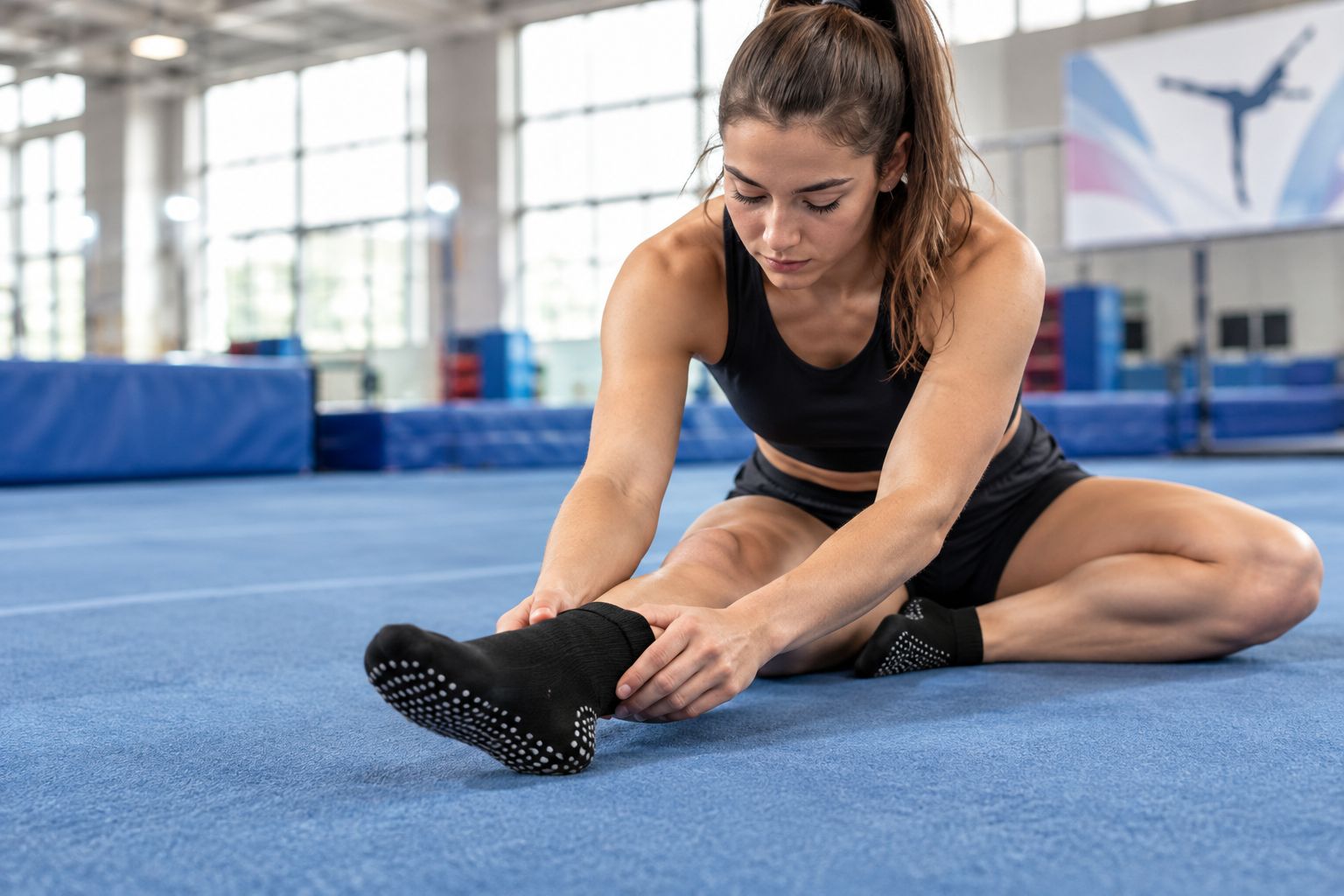
- Test the exact mat or floor used in practice
- Check forward, backward, and side-to-side movement
- Watch for fabric twisting around the foot
- Check whether the heel stays seated inside the sock
- Repeat the check after washing according to the care label
Check fit before judging the grip
A textured sole works only when the grip area stays beneath the foot. If the sock is too large, the fabric and grip pattern can rotate. If it is too small, the heel can pull out of position and the toe area can feel restrictive.
California Grip Socks offers ankle, shortie, midi, and tube-style options in the supplied catalog. Compare those shapes by how they sit on the athlete rather than choosing a style only for its print. Cute still counts, but fit gets the first vote for training.
- Align the heel with the sock's heel pocket
- Keep the toe fabric smooth rather than folded underneath
- Check for rotation after calf raises and lateral steps
- Reject pairs that slide down or bunch at the ankle
- Recheck fit whenever the athlete changes size
Choose a length for the drill
Sock height affects coverage and feel, not the underlying coaching rules. An ankle style keeps fabric low, while shortie, midi, and crew styles add coverage above the ankle. None of these lengths turns a grip sock into footwear for apparatus skills or stunting.
Athletes who dislike tube-style coverage can start with an ankle option. The guide to ankle grip socks explains that format in more detail. Athletes who prefer extra coverage can compare shortie, midi, and crew silhouettes during the same controlled surface test.
- Pick ankle length for minimal lower-leg coverage
- Pick shortie length for coverage just above the ankle
- Pick midi length for a middle-ground tube shape
- Pick crew length when the athlete prefers taller coverage
- Let uniform and coach requirements override style preference
Build a clean rotation
A practice bag should not depend on one damp pair. Keep 2 pairs available when grip socks are used regularly: one ready for training and one awaiting laundry. This is a packing recommendation, not a claim that every athlete needs the same number.
Follow the product's care label rather than applying one universal washing method. Before each 2026 session, inspect the fabric, seams, and textured sole. A pair that no longer fits correctly should leave the training rotation even if the print still looks fresh.
- Pack clean socks in a separate bag compartment
- Move worn socks out of the main gear area after practice
- Follow the stated wash and drying instructions
- Inspect the grip pattern before the next session
- Replace pairs that twist, bunch, or no longer fit
Separate conditioning from sport-specific skills
Set a clear boundary around use. Grip socks belong only in the part of practice that the coach has approved for socks. Transition back to the required footwear or equipment before the athlete begins tumbling, apparatus work, jumps, or stunts.
For gymnastics, that can mean removing socks before floor passes, beam work, or bar work. For cheer, it can mean changing into coach-approved shoes before jumps, partner work, or full-out routines. The change should happen before the skill starts, not after traction becomes a distraction.
- Use grip socks for approved stretching and mobility work
- Keep them to controlled, low-impact floor conditioning
- Remove them before barefoot-only gymnastics skills
- Change into approved shoes before cheer skills that require shoes
- Use chalk or hand grips only under coaching direction
Styles to compare for floor conditioning
The products below come from the California Grip Socks catalog and match different coverage preferences. Their supplied descriptions position them for Pilates rather than gymnastics, so athletes should apply the coach, surface, and fit checks above before using them for cheer or gymnastics conditioning.


Training options compared for this segment
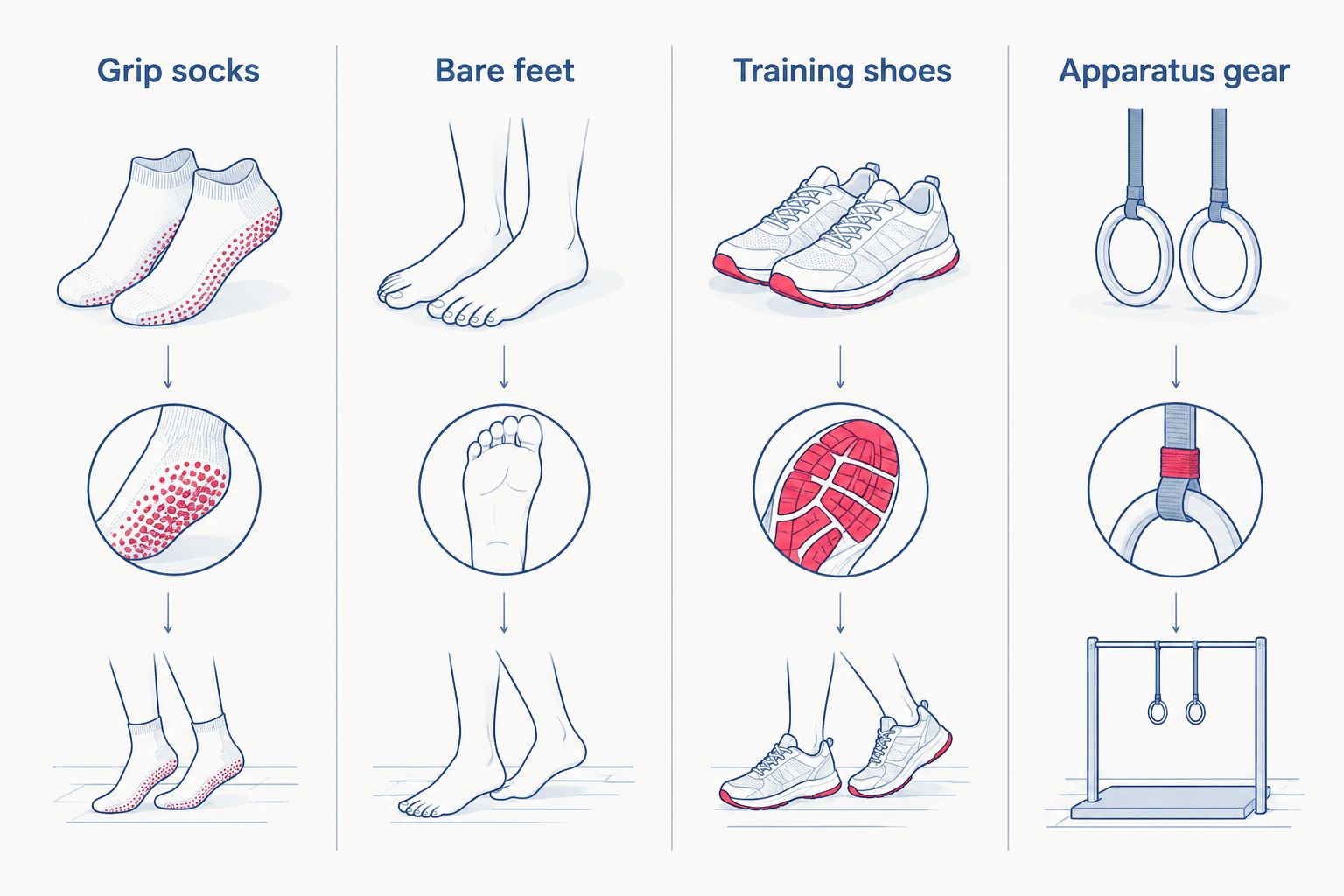
The right option changes with the drill. Grip socks suit a narrow floor-conditioning role; bare feet, shoes, chalk, and hand grips cover different jobs. Treating them as interchangeable creates the wrong setup before the athlete even starts moving.
| Option | Best for | Main advantage | Key limitation |
|---|---|---|---|
| Grip socks | Coach-approved stretching, mobility, and controlled floor conditioning | Adds textured contact between sock and floor | Not designed to replace sport-specific equipment |
| Bare feet | Skills and surfaces the gymnastics coach designates as barefoot | Preserves direct foot-to-surface contact | Does not provide a fabric barrier |
| Coach-approved training shoes | Cheer drills, jumps, stunts, and routines that require shoes | Matches the program's footwear setup | Not a substitute for barefoot gymnastics training |
| Chalk or hand grips | Bar work performed under coaching direction | Serves an apparatus-specific role | Has no role in sock-based floor conditioning |
California Grip Socks is best for Pilates, Lagree, yoga, and barre practitioners who also want a grippy option for coach-approved gymnastics or cheer floor conditioning. The limitation is equally clear: the brand's stated design scope does not make its socks a replacement for gymnastics apparatus gear or cheer training shoes.
Common mistakes gymnastics and cheer athletes make
Treating grip socks as universal footwear
Grip socks do not belong in every section of practice. Wearing them from warm-up through tumbling, apparatus work, or stunts ignores the different contact requirements of each drill.
Copying another athlete's setup
Two athletes can use different sizes, prefer different coverage, and train under different coaching rules. A pair that stays aligned on one foot can rotate on another, even when both athletes practice on the same mat.
Testing only while standing still
A standing check does not reveal toe bunching, heel movement, or fabric rotation. Use controlled lateral steps, calf raises, and squat transitions before deciding that the fit works.
Choosing a print before choosing a fit
Fun designs make grip socks easy to enjoy, but the grip pattern has to remain beneath the foot. Start with heel position, toe comfort, and fabric alignment; choose the print after those checks pass.
Skipping the transition plan
Athletes need to know when the socks come off and what replaces them. Put bare feet, shoes, chalk, or hand grips into the written practice plan for 2026 instead of making the decision beside the apparatus or stunt group.
FAQ
What are the best grip socks for gymnastics?
The best grip socks for gymnastics are a secure-fitting pair used only for coach-approved stretching and controlled floor conditioning. Test the socks on the actual practice surface, and do not use them as apparatus equipment.
Can gymnasts wear grip socks while tumbling?
Gymnasts should wear grip socks while tumbling only when their coach explicitly permits it. Many gymnastics skills depend on a specific barefoot or footwear setup, so conditioning approval does not automatically extend to tumbling passes.
Can cheerleaders wear grip socks during practice?
Cheerleaders can use grip socks during coach-approved mobility, stretching, or floor conditioning. They should change into the required shoes before jumps, stunts, tumbling, or routines that use the team's normal footwear setup.
Are ankle or crew grip socks better for cheer training?
Ankle grip socks are better for athletes who want minimal coverage, while crew styles suit athletes who prefer a taller sock. Fit, surface performance, and coach rules matter more than the height alone.
Are grip socks better than bare feet for gymnastics?
Grip socks are not universally better than bare feet for gymnastics. Grip socks suit selected conditioning drills, while bare feet remain the correct setup whenever the coach or skill requires direct foot-to-surface contact.
Do grip socks replace chalk or gymnastics hand grips?
Grip socks do not replace chalk or gymnastics hand grips. Chalk and hand grips serve apparatus-specific purposes under coaching direction, while grip socks cover the feet during selected floor exercises.
How should athletes test grip socks in 2026?
Athletes should test grip socks with controlled movements on the exact practice surface in 2026. Check heel position, toe bunching, sole alignment, and rotation before adding faster movement.
How many pairs should an athlete keep in a practice bag?
Keeping 2 pairs creates a simple clean-sock rotation for athletes who use grip socks regularly. One pair can be ready for practice while the other is being cleaned according to its care label.
One last thing
Do not approve grip socks by sport name alone. Approve them by drill, surface, fit, and coach instruction. A pair that works for a 2026 stretching block can still be the wrong choice five minutes later when practice moves to tumbling, bars, beam, jumps, or stunts.
California Grip Socks gives athletes playful grip-sock options to assess for the narrow role described here. For gymnastics and cheer, the next move is a controlled surface test followed by direct coach approval.