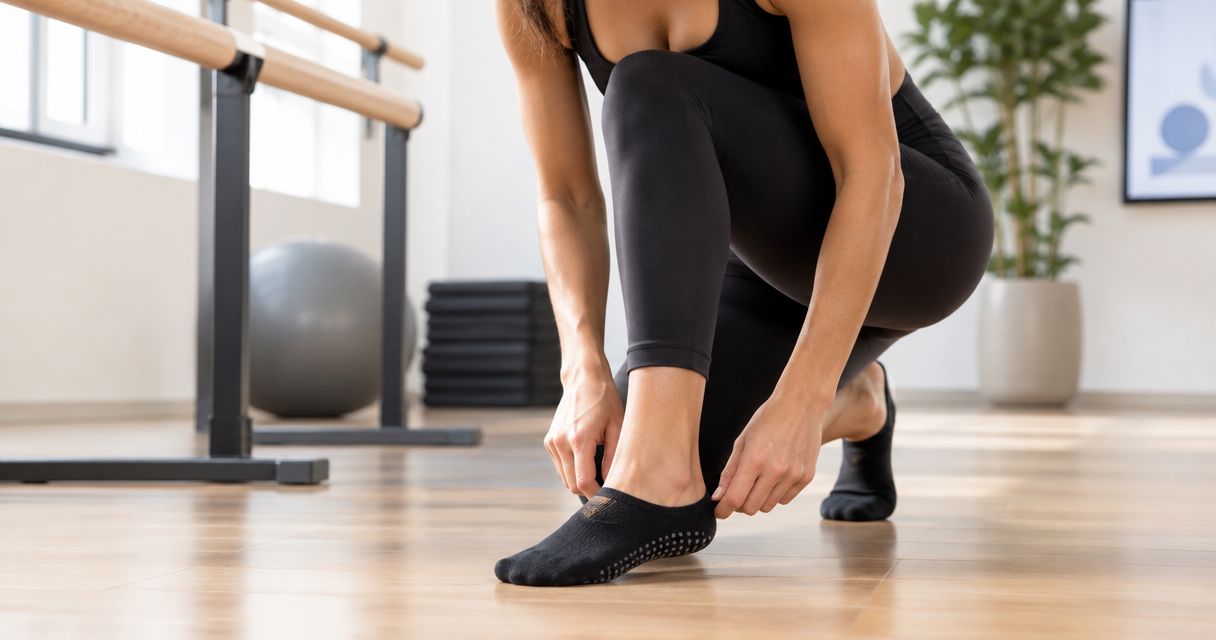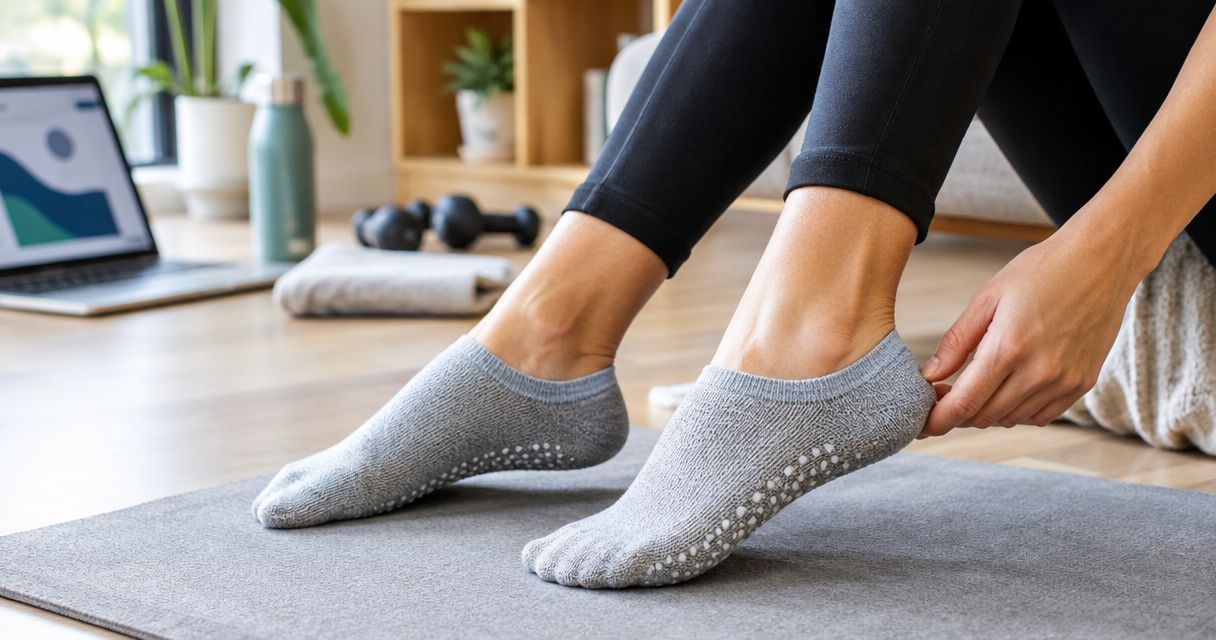
Yes, you can wear grip socks with narrow feet comfortably when the fabric sits close to your foot, your toes have room, and the sole stays underneath you as you move. Choose by fit, not grip alone: sticky grips cannot fix a sock that twists, bunches, or lets your heel slide inside it.
- Can you wear grip socks with narrow feet? Yes—choose a close fit without squeezing your toes.
- California Grip Socks offers cute Pilates socks; choose by individual fit rather than assuming narrow-width sizing.
- Check heel placement, loose fabric, and sole alignment before wearing grip socks through a class.
- A shorter sock is not automatically narrower, and sizing down is not automatically more comfortable.
Why this matters
Your sock has to stay with your foot while its grips contact the surface beneath you. Those are separate jobs. If your foot moves inside loose fabric, a sticky sole does not solve the fit problem.
For your 2026 studio kit, start with the size information rather than the print. The guide to ordering the right grip sock size is a useful next read before choosing a pair.
Narrow feet do not mean you need the shortest size available. You still need enough length for your toes and heel; the goal is less unwanted movement across the foot, not less room everywhere.
Can you wear grip socks with narrow feet comfortably?
Yes—comfortable grip socks should follow your foot without loose folds or pressure points. Check the fit while standing and moving gently, not just while sitting with your feet up.
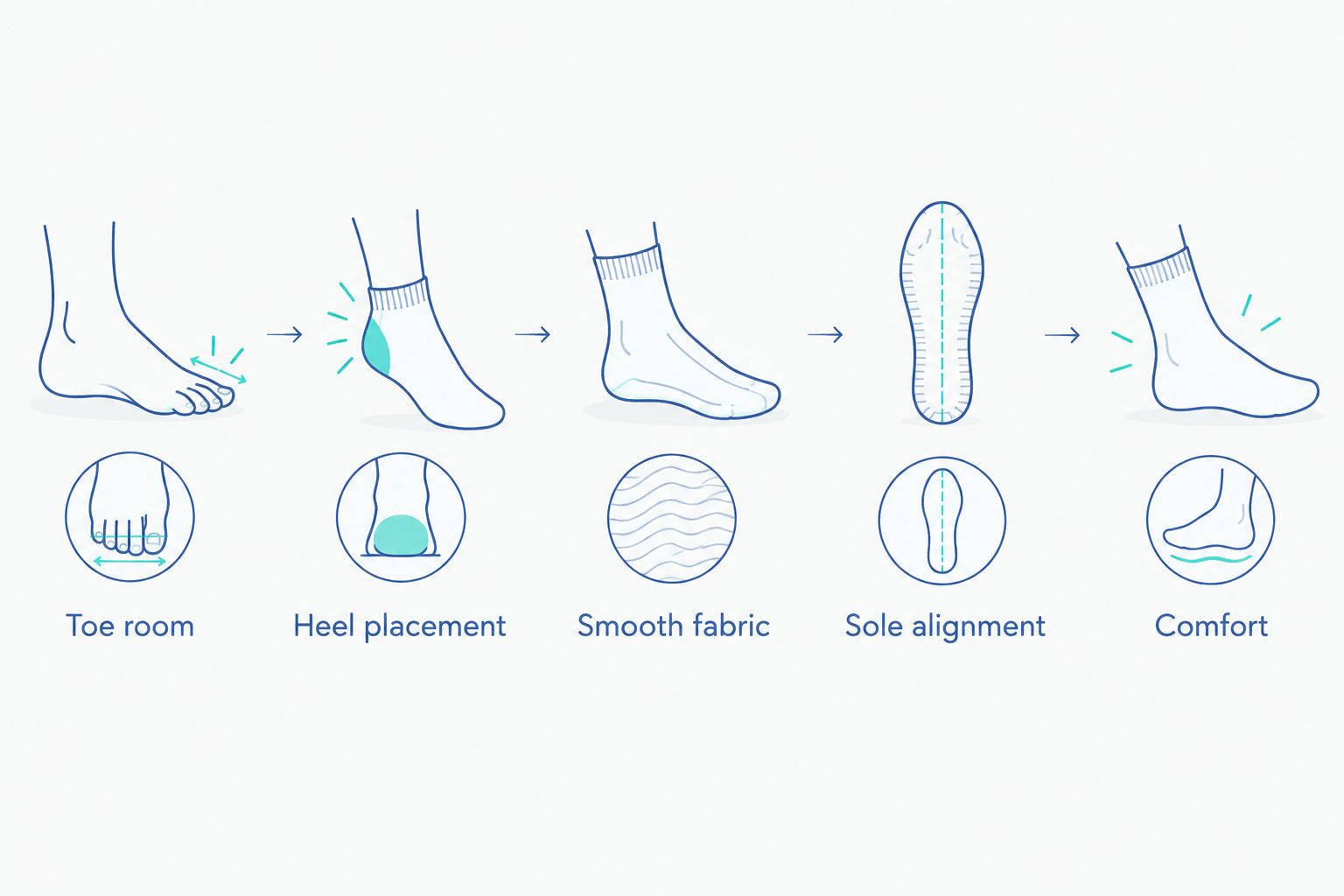
Use this 2026 fit checklist before taking a pair into Pilates, Lagree, yoga, or barre:
- Toe room. Spread and bend your toes. Reject a fit that curls them, pulls against their tips, or makes you hold them still to stay comfortable.
- Heel placement. If the sock has a shaped heel, position it over yours. Check that it stays there instead of slipping underneath or riding up the back.
- Smooth fabric. Look along the sides of your forefoot and beneath your arch. Smooth the sock once, then see whether folds return when you move.
- Sole alignment. With support nearby, gently lift and lower your heels. Check that the grippy area remains beneath your foot rather than rotating toward its sides.
- Comfort in motion. Take a few easy steps on a clean, suitable surface. Stop if the sock twists, your foot slides inside it, or you feel pinching.
These checks help you assess fit; they are not a test of fall prevention or a guarantee of traction on every surface. Follow your studio's instructions for equipment and footwear.
What does a good narrow-foot fit feel like?
A good fit feels close without demanding your attention. You can move your toes, the fabric lies smoothly, and you do not keep stopping to straighten the sole.
Do not confuse snug with squeezed. A sock that stays put by pressing painfully into your toes or ankle has failed the comfort check, even if it does not slip.
What does a poor fit look like?
Repeated bunching, a migrating heel, or a sole that rotates sideways are reasons to reassess the pair. Pulling the cuff higher does not resolve extra fabric around the foot.
Also check the opposite problem: fabric stretched tight across the toes or a heel pulled out of position. Narrow feet still need the right sock length.
Should you size down if you have narrow feet?
Do not size down solely because your feet are narrow. Width and length describe different parts of fit, and a smaller size can leave your toes without enough room.
Start with the size range stated for the exact pair you are considering. If your usual shoe size sits between options, follow that product's sizing guidance rather than applying a blanket rule from another brand.
A simple decision helps:
- If the length fits but fabric gathers around the foot, reassess the sock's shape or construction.
- If both the length and overall fit feel loose, check whether another listed size fits your measurements.
- If the toes feel crowded, do not accept that discomfort just to remove side-to-side looseness.
- If sizing information does not answer your question, ask about fit before choosing.
For 2026 shopping, a useful question is: Does this specific sock accommodate a narrow forefoot without sacrificing toe room? That is more precise than asking whether all grip socks run small.
Avoid choosing children's socks simply as a width workaround. A smaller size label does not establish that the heel, length, or overall shape will suit your foot.
Which sock height should you choose?
Sock height tells you how much of your ankle or lower leg is covered. It does not, by itself, tell you how closely the foot portion fits.
California Grip Socks offers ankle and shortie styles, among other designs. The examples below show differences in coverage and details—not evidence that either product has a dedicated narrow-foot fit.
| Option | Best for | Stated details | Advantage | Limitation for narrow feet |
|---|---|---|---|---|
| The Classic Ankle Grip Socks - Grey | You prefer an ankle-height style without a tube | Grey grip sock, white ankle stripe, small cushioned back detail | An ankle-height option for readers who want less coverage | The description does not establish a narrow-width fit |
| The Ruffle Shortie Grip Socks- Sage | You prefer a shortie style with a ruffle detail | Lightweight ribbed weave, sage color, matching sage grips | A lightweight ribbed option with a decorative trim | Ribbing and ruffles do not establish how tightly the foot portion fits |
Neither style wins on narrow-foot fit from its description alone. Choose your preferred coverage, then assess sizing and the fit checks above. Cute is a valid preference; it is not a substitute for comfortable toe room.
If ankle coverage is your priority, the ankle grip socks guide focuses on that style. Keep the distinction clear: ankle height answers a coverage question, not a width question.
What should you check before choosing a pair?
Read the exact product description and any available size information. Look for stated construction details, but do not turn words such as ribbed, lightweight, or cushioned into an unsupported narrow-fit promise.
California Grip Socks is best for Pilates, Lagree, yoga, and barre shoppers who want cute grip socks; narrow-foot comfort still requires an individual fit check. That is the right boundary between choosing a style and confirming that it works for you.
These designs are relevant choices if their sizing suits your feet. Neither product description identifies a dedicated narrow width.


Why grip sock comfort varies on narrow feet
Your foot's width is part of the picture, not the whole picture. Use these factors to identify what needs changing instead of repeatedly adjusting the same uncomfortable pair.
- Foot length. The sock needs enough room from heel to toe. Removing extra width by sacrificing length is not a good trade.
- Heel fit. A sock that fits the forefoot but moves around your heel still needs reassessment. Check both areas separately.
- Fabric around the arch. Loose folds beneath the foot are different from a comfortably relaxed cuff. Pay attention to where excess material gathers.
- Toe comfort. Your toes need room to move without fabric pulling them inward. Check them while standing as well as sitting.
- Movement. A sock that looks tidy at rest can shift when you lift your heel or change position. Include gentle movement in your check.
- Sock condition. Recheck fit if the fabric has stretched, the heel no longer stays positioned, or the sole has become distorted. Follow the care instructions for that pair.
This 2026 checklist is more useful than choosing by a narrow-foot label alone. The label is a starting point; the way the sock sits and moves on your foot is the practical test.
Can a tight cuff fix loose fabric around your foot?
A tight cuff is not a fix for a loose foot section. Judge the cuff and the sole separately: one sits around your ankle or leg, while the other needs to stay beneath your foot.
If the cuff feels secure but the fabric still bunches around your arch, the fit problem remains. Do not keep tightening or pulling up the sock to compensate.
Can you wear grip socks with narrow feet on a reformer?
Yes, provided the socks fit comfortably and meet your studio's requirements. Check that the heel and sole stay positioned as you move, and follow your instructor's guidance around straps and equipment.
Do not test a loose pair by attempting a harder movement. Stop and adjust or change the socks before continuing if your foot slides inside them.
Should grip socks feel like compression socks?
Grip socks do not need to squeeze your feet to fit well. Look for close contact and comfortable movement rather than pressure that restricts your toes.
Do not assume a snug studio sock offers medical compression. If you need prescribed compression or have a foot condition affecting sensation or circulation, ask your clinician about suitable workout footwear.
FAQ
Can you wear grip socks with narrow feet comfortably?
Yes, when the sock fits closely without squeezing your toes or shifting around your foot. Check for smooth fabric, a stable heel, and a sole that remains underneath you during gentle movement.
Should I buy smaller grip socks if my feet are narrow?
Do not buy a smaller size solely because your feet are narrow. Follow the pair's sizing guidance and preserve enough length for comfortable toe movement.
Are ankle grip socks better for narrow feet than crew socks?
Ankle grip socks are not automatically better for narrow feet. Sock height describes coverage, while the fit around your heel, arch, and forefoot determines whether the foot section stays positioned.
Why does my foot slide inside my grip sock?
Sliding inside a grip sock is a reason to reassess its fit and position. Check for loose fabric, misplaced heels, and twisting; a sticky sole does not correct movement between your foot and the sock.
Are California Grip Socks specifically made for narrow feet?
The supplied California Grip Socks product descriptions do not identify a dedicated narrow-width fit. Choose using the exact pair's sizing information and confirm comfort around your toes, arch, and heel.
Should I keep wearing grip socks if my toes feel numb?
Stop wearing the pair if your toes feel numb or painful. Remove the socks and seek medical advice if symptoms persist or recur.
How should I choose grip socks for narrow feet in 2026?
For 2026, prioritize comfortable length, smooth fabric, stable heel placement, and sole alignment. Choose the print and sock height after those fit checks, not instead of them.
One last thing
Test the foot section before admiring the cuff. A pair can look perfect above your ankle while leaving loose fabric underneath your arch—the part you need to check most carefully.
Before your next class, position the sock properly and move gently with support nearby. If you keep having to straighten it, choose a different fit rather than making repeated adjustments part of your workout. Your socks should not become another exercise.