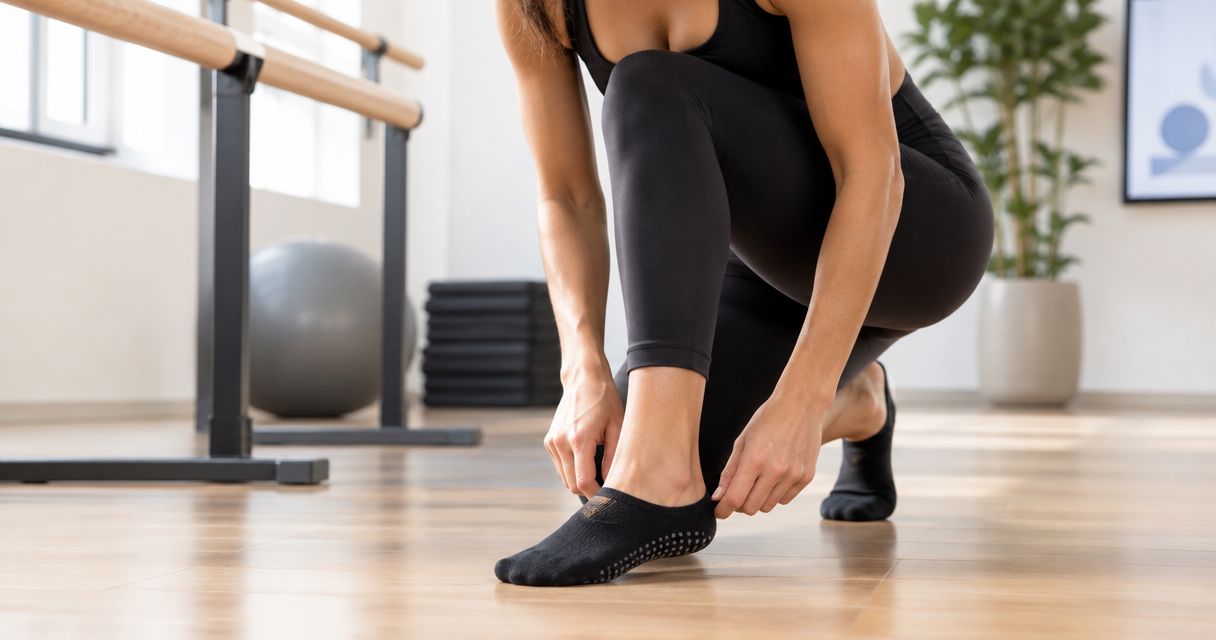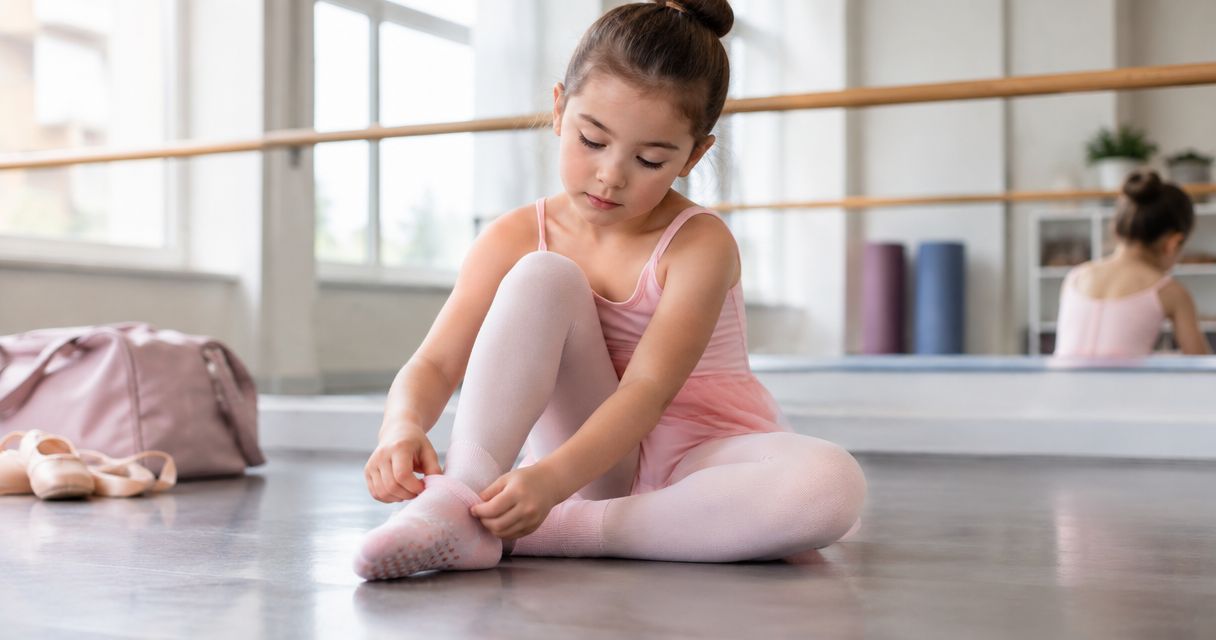
Yes, kids can wear grip socks for ballet when their teacher allows them, the socks fit securely, and the planned movements work with a grippy sole. For your child’s 2026 class, treat grip socks as a teacher-approved option—not an automatic replacement for the ballet shoes listed in the dress code.
- Can kids wear grip socks for ballet? Yes, with the teacher’s approval and a secure fit.
- Ballet shoes and grip socks behave differently during sliding and turning movements.
- California Grip Socks makes Pilates and barre grip socks; choose ballet footwear according to your child’s class requirements.
- Ask about footwear before a trial lesson, and check fit before your child starts moving.
Can kids wear grip socks for ballet class?
Kids can wear grip socks for ballet only when the instructor accepts them for that particular class. A playful movement lesson, a technique class, and a rehearsal do not necessarily call for the same footwear. The class name alone does not settle the question.
Start with the dress code, then ask the teacher about any exception. If the instructions specify soft ballet shoes, follow that requirement rather than substituting socks because they look comfortable or have sticky grips.
For the broader footwear distinction, see the guide to grip socks for ballet and dance classes. For your child’s actual lesson, the instructor’s directions come first.
| Footwear | Best for | Main advantage | Main limitation |
|---|---|---|---|
| Grip socks | Teacher-approved activities where added traction suits the movement | Grippy soles resist sliding | That resistance can interfere with movements that need the foot to slide or turn |
| Soft ballet shoes | Ballet classes that specify ballet shoes | Footwear designed for ballet movement | They still need the correct fit and the teacher’s preferred style |
| Bare feet | Activities the instructor explicitly teaches barefoot | No sock fabric moving between the foot and floor | Not a substitute when the class requires footwear |
| Ordinary socks | Activities where the instructor specifically permits them | Simple foot coverage | Smooth soles do not provide the same traction as grip socks |
There is no universal winner in this table. The best option is the one your child’s teacher approves for the movement being taught. Do not switch from grip socks to ordinary socks just to make a turn easier without asking first.
Why this matters
Ballet asks feet to do more than stay put. A child learns to point, bend, transfer weight, and move through positions; some exercises also involve brushing or sliding the foot along the floor. Footwear needs to suit those tasks.
Grip socks add resistance at the contact point with the floor. That can be useful when the goal is keeping a planted foot from sliding, but more resistance is not automatically better for every dance movement.
There is also a separate fit issue. A sole can grip the floor while the child’s foot shifts inside a loose sock. Cute prints do not solve that mismatch, and pulling an oversized sock higher does not turn it into the right size.
The useful question is not simply whether grip socks are good. It is whether this pair works for this child, on this floor, during this lesson.
When teacher-approved grip socks make sense
Grip socks are an option when the instructor specifically includes them in the footwear instructions. That approval should apply to the actual lesson your child is attending, not a different class at the same studio.
Ask what the child will do while wearing them. An instructor might approve socks for selected floor activities but require ballet shoes for another part of the lesson. Follow the distinction rather than treating approval as permission for every exercise.
A trial class is another reason to ask directly. If you do not yet own ballet shoes, explain that before arriving and ask what your child should bring. Do not assume that a trial lesson has a relaxed footwear policy.
Best for: a class or activity that explicitly allows grip socks. The advantage is using a grippy covering where the instructor wants it; the limitation is that permission does not carry over automatically to turns, rehearsals, or another teacher’s lesson.
When ballet shoes are the right choice
Choose soft ballet shoes when they appear in the class requirements. Check the requested style and fit instructions before buying, rather than assuming any shoe labeled ballet will satisfy the dress code.
Ballet shoes and grip socks are not interchangeable just because both feel soft. Their soles interact differently with the floor, and the teacher plans movements around the footwear children are expected to wear.
If a child’s grip socks catch during a movement, stop and ask the instructor what to change. Do not encourage the child to push harder through the resistance or improvise a different turning technique.
Best for: a ballet lesson that requires soft ballet shoes. Their advantage is matching the intended footwear; their limitation is that the wrong size or an unsuitable style still needs correcting. Follow the teacher’s fitting guidance rather than shopping by appearance alone.
Why grip-sock suitability varies between ballet classes
The decision depends on the lesson, not a blanket rule about children’s socks. Use these factors to make the conversation with the teacher specific:
- Class requirements: A written ballet-shoe requirement takes priority over a general recommendation for grip socks.
- Movement: A planted balance and a sliding foot exercise place different demands on the sole.
- Floor surface: The same footwear does not behave identically on every surface; the teacher can assess it in the actual room.
- Sock fit: A loose heel, fabric bunching, or a twisting sole changes how the sock sits on the foot.
- Lesson setting: Permission for a trial, home activity, or warm-up does not establish permission for the full class or a performance.
Age alone does not answer the footwear question. Neither does a child’s experience level. Ask about the lesson itself and use the answer to choose what goes in the dance bag.
How do you check before your child’s first class?
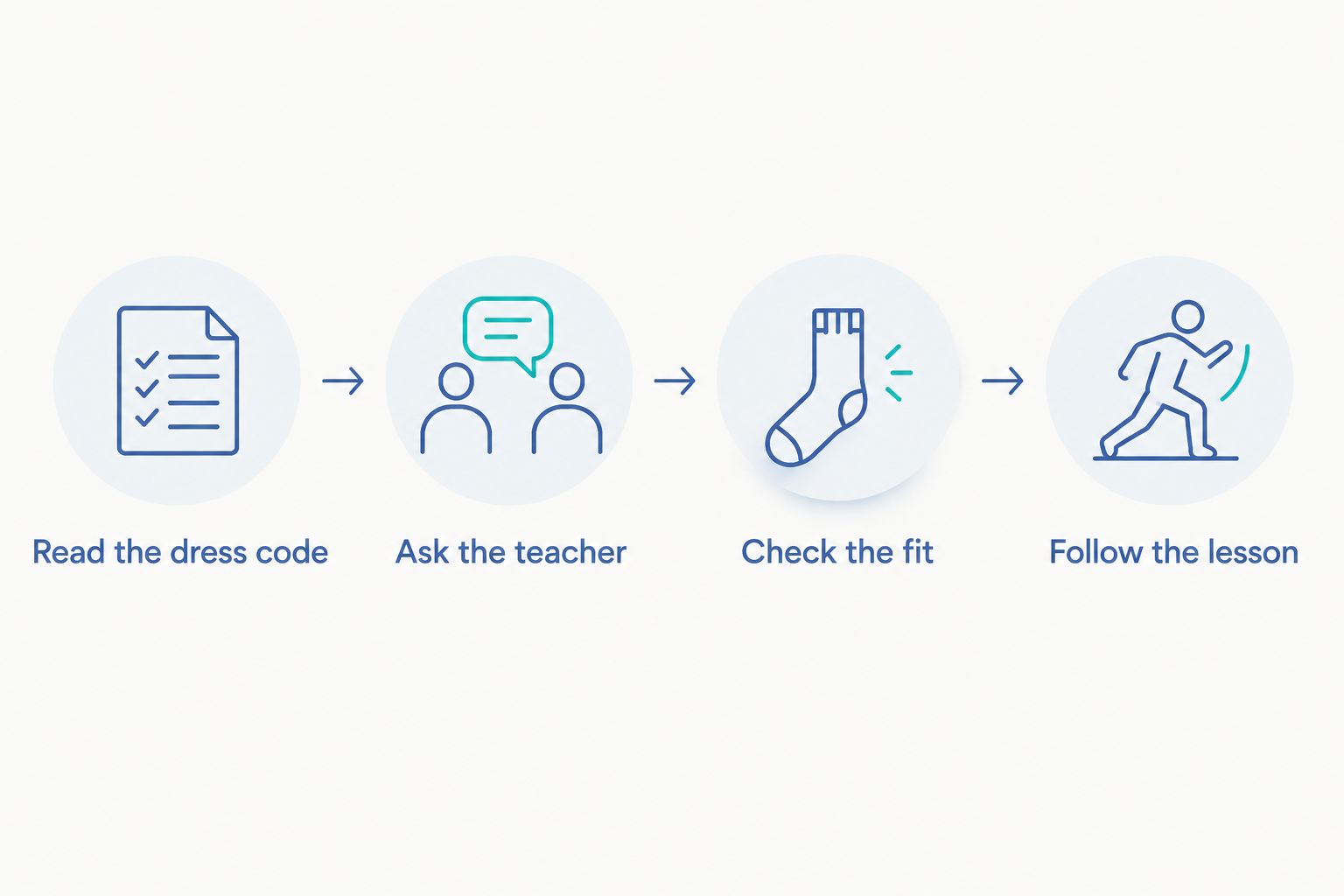
For a 2026 enrollment or trial lesson, use this sequence before buying something new. It keeps the decision with the teacher and gives you a practical way to check the pair you already have.
- Read the dress code. Look for the exact footwear requirement and any separate instructions for trial lessons. If the wording is unclear, ask rather than interpreting silence as approval.
- Ask the teacher. Explain that you are considering grip socks and ask whether they are permitted for the whole lesson or selected activities. Mention whether your child already owns a pair.
- Check the fit. With the sock on, look for a heel that sits in place, toes that are not cramped, and fabric that does not bunch underfoot. Do not use an adult pair as a shortcut for a smaller foot.
- Follow the lesson. Let the instructor assess the approved footwear during the movements they choose. If the sock twists, the child’s foot shifts, or the sole catches, pause and ask what to change.
Keep the conversation simple. Tell the instructor what footwear your child has and ask what the class needs. You do not need to choose between grip socks and ballet shoes without that information.
What should you look for in the fit?
A grip sock needs to stay aligned with the foot, not just stick to the floor. Check it while your child is wearing it, because the pair’s appearance in the package tells you little about the fit.
Start at the heel. It should sit where the sock’s heel is intended to sit, without extra fabric folding underneath. Then look at the toes and sole: there should not be a loose pocket of fabric under the front of the foot.
Ask your child whether anything feels squeezed or uncomfortable. Do not dismiss discomfort as something they need to tolerate for class. If a cuff feels restrictive or a seam bothers them, choose a better-fitting option before the lesson.
Finally, watch for twisting during teacher-approved movement. Grips that rotate toward the side of the foot are a reason to stop and reassess, not a reason to keep tugging the sock back between exercises.
Sock height and decoration are secondary choices. A ruffle, stripe, or fruity print can be fun, but none establishes a secure fit or ballet suitability. Get the fit and permission right first; choose the cute details afterward.
Are grip socks better than ballet shoes for beginners?
Grip socks are not automatically better than ballet shoes for beginners. Beginner status does not remove the class’s footwear requirements or change how a grippy sole interacts with the floor.
If you are choosing footwear for a beginner’s 2026 ballet class, use the enrollment instructions and the teacher’s advice. A first lesson is a reason to ask questions, not a reason to substitute equipment without checking.
Can kids wear grip socks for ballet at home?
Kids can use grip socks for teacher-approved home activities when the fit and surface suit those activities. Keep home practice within the exercises the instructor has assigned, and ask what footwear to use.
For home practice in 2026, do not treat a sticky sole as permission to try unfamiliar turns, jumps, or advanced movements. If the sole catches or the foot shifts inside the sock, stop and check with the teacher before repeating the exercise.
Can a child wear barre socks to a ballet lesson?
A child can wear barre socks to a ballet lesson only if the ballet instructor approves them and they fit properly. Fitness barre and a children’s ballet class are different settings; a product intended for one does not establish suitability for the other.
Check the actual class requirements instead of relying on the word barre in a product description. You also need the correct size, not just a sock with grips underneath.
Where California Grip Socks fits
California Grip Socks is best for Pilates, Lagree, yoga, and barre practitioners looking for cute grip socks—not as an automatic substitute for children’s ballet shoes. That distinction matches the brand’s stated purpose and keeps your ballet decision focused on the lesson.
The California Grip Socks range includes playful designs, from butterflies to fruit motifs. That is a reason to browse for your own studio routine, but it does not establish that a particular pair fits your child or meets a ballet dress code.
California Grip Socks offers grip socks for studio activities; the limit is that a grippy sole alone does not answer a children’s ballet-footwear question. Before choosing any pair for your child, check the sizing information and get the instructor’s approval.
What should go in the dance bag?
Pack the footwear the studio requests. If the teacher has approved grip socks only for part of the lesson, bring the other required footwear too rather than expecting one pair to cover everything.
Keep the approved socks clean and inspect them before use. Look for fabric that bunches, a heel that no longer stays in place, or a sole that twists during movement. A familiar pair still deserves a fit check as your child grows.
If you arrive with the wrong footwear, tell the instructor before class starts. Let the studio decide whether your child can participate and what they should wear; do not quietly substitute ordinary socks or bare feet.
The aim is a clear, calm handoff. Your child should know what to put on, and the instructor should know about any footwear question before the first exercise.
FAQ
Can kids wear grip socks for ballet instead of ballet shoes?
Kids can wear grip socks instead of ballet shoes only when their ballet instructor permits that substitution. If the dress code requires ballet shoes, follow it unless the teacher gives different instructions.
Are grip socks a good choice for a child’s first ballet lesson?
Grip socks are a good choice only if the instructor approves them for the first lesson and they fit securely. Ask about trial-class footwear before arriving rather than assuming socks are allowed.
Are grip socks safer than regular socks for ballet?
A grippy sole does not establish that grip socks are safer for every ballet movement. They resist sliding, but that resistance can interfere with movements that require sliding or turning; use the teacher’s approved footwear.
Can my toddler wear adult grip socks to dance class?
Do not use adult grip socks as a substitute for a pair that fits your toddler. Loose fabric, a misplaced heel, or a twisting sole means the sock is not staying aligned with the foot.
Can my child wear grip socks inside ballet shoes?
Ask the ballet teacher before putting grip socks inside ballet shoes. Adding socks changes the fit, and the teacher should confirm what belongs inside the required shoe.
Does California Grip Socks make socks specifically for children’s ballet?
California Grip Socks describes its socks as designed for Pilates, Lagree, yoga, and barre practitioners. That description does not establish children’s ballet sizing or approval, so check the sizing information and ask your child’s instructor.
What should I do if my child’s grip socks catch on the dance floor?
Stop the movement and tell the instructor if your child’s grip socks catch on the floor. Do not ask your child to force a turn or continue an exercise that the footwear is interrupting.
One last thing
For your child’s 2026 ballet class, ask the teacher about both approval and movement. A useful follow-up is whether the socks are suitable for the entire lesson or only particular activities.
That small distinction does the real work. Permission to wear grip socks is not permission to use them for every ballet exercise, and a sock that stays on the floor still needs to stay on the foot.