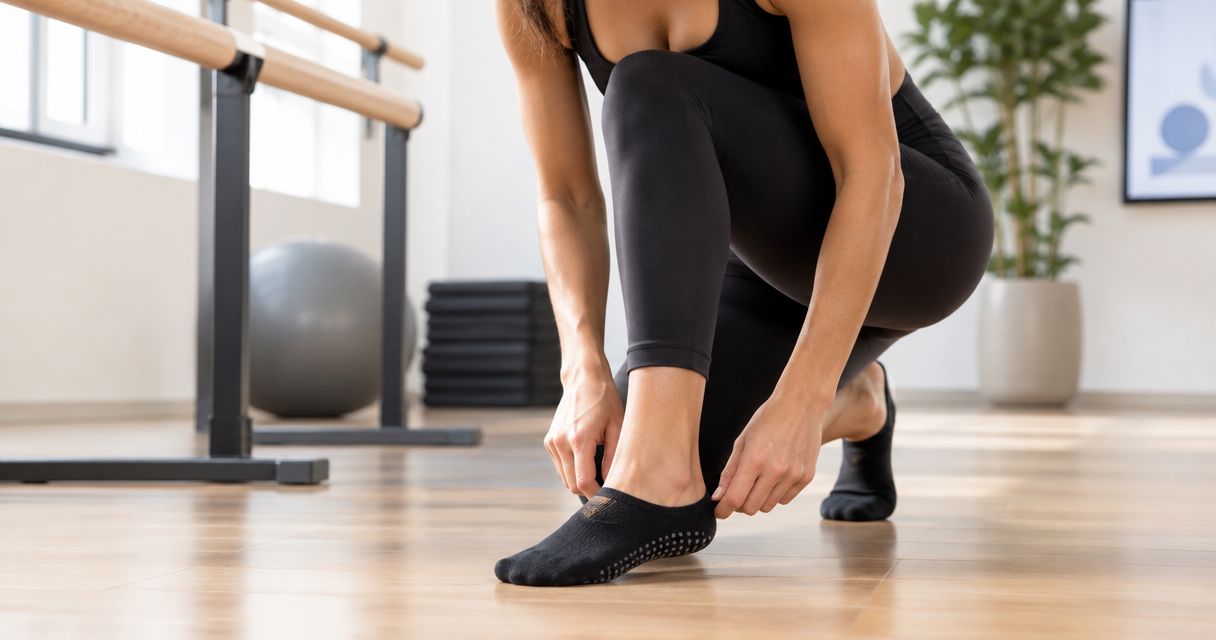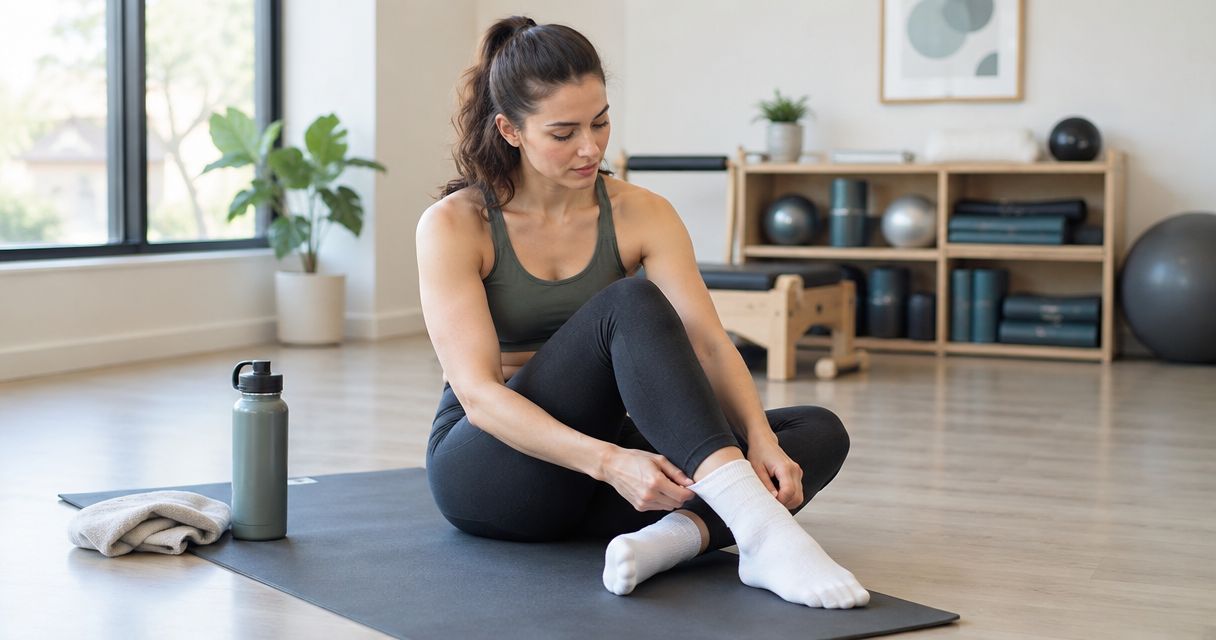
You can wear regular socks to Pilates if your studio allows them and they give you enough traction for the exercises; they are not a substitute when grip socks are required. Smooth soles can slide against the floor or equipment, so check the class rules before you pack. For your 2026 class prep, choose permitted footwear that stays put—not just a pair that matches your outfit.
- Can you wear regular socks to Pilates? Only when your studio permits them and traction suits the exercises.
- Pilates grip socks add sole grips; regular socks do not provide the same contact surface.
- Barefoot Pilates is an option only when your instructor and studio allow it.
- Check the class rules, sock fit, and sole condition before stepping onto a Pilates reformer.
Why this matters
You want to focus on the movement, not on a sock sliding around your foot. Pilates includes different positions and contact points, so the pair that feels fine while you walk into class needs another check before you exercise.
Permission and suitability are separate questions. A studio allowing regular socks does not mean every regular pair works equally well. Loose fabric, a shifting heel, or a smooth sole can interrupt your footing.
If you are choosing your first pair, the Pilates grip socks guide gives you a starting point. First, though, confirm what your actual class asks you to wear. That instruction comes before any shopping list.
Can you wear regular socks to Pilates?
Yes, when the studio permits regular socks and your instructor considers them suitable for the session. If the booking instructions require grip socks, regular socks do not meet that requirement. Having socks on is not the same as having grips underfoot.
There is no single footwear answer that covers every Pilates class. Mat work and reformer work involve different surfaces and movements, and the instructor decides what is appropriate for the exercises you will do.
Use this comparison to separate the choices. It explains their practical differences, not a universal studio dress code.
| Footwear | Best for | Main advantage | Main limitation | Class decision |
|---|---|---|---|---|
| Regular socks | Sessions that explicitly allow them | Cover your feet using a familiar pair | Smooth soles lack added grip; fabric can shift | Wear only with permission and suitable traction |
| Grip socks | Classes that require socks with sole grips | Add a grippy contact surface underfoot | Still need correct fit and intact grips | Choose when the class requires them |
| Bare feet | Sessions that explicitly allow barefoot practice | Remove the sock layer between foot and surface | Do not satisfy a socks-required policy | Confirm before removing your socks |
Do not treat the table as a safety guarantee. Grip socks do not prevent every slip, and bare feet do not automatically make an exercise suitable. Your instructor's setup, the contact surface, and your movement still matter.
For a new booking in 2026, read the current class instructions rather than relying on what another studio allowed last time. Same workout category. Different rules.
Regular socks: allowed does not mean ideal
Regular socks cover your feet, but a smooth fabric sole is different from a sole with added grips. The distinction matters when your feet need to stay planted rather than slide.
Picture a standing exercise with your feet apart. If a sock moves across the surface or twists around your foot, you lose the position you were trying to hold. Stop and ask the instructor to help you adjust; do not keep repeating the movement to see whether it improves.
Also check what is happening inside the sock. A pair can look secure from the outside while your heel lifts or your toes bunch against extra fabric. A familiar everyday fit is not enough if the sock shifts during class.
Best for: a session where regular socks are explicitly accepted and the instructor approves your footing. Their upside is simple: you can use a pair you already own. Their downside is equally clear: they do not add the sole grips that a grip-sock requirement calls for.
Grip socks: useful traction, not a permission slip
Grip socks add grippy material to the bottom of the sock. That changes the contact surface compared with plain fabric, but the sock still needs to fit your foot properly.
A grippy sole cannot fix a loose heel. If the fabric rotates, the grips can move away from the area where you need contact. Check the fit before class, then tell your instructor if anything shifts during an exercise.
Look at the underside, too. If grips are peeling, worn away, or covered in debris, do not assume the pair works as it did when new. Follow the sock's care instructions and assess its condition before using it again.
Best for: Pilates sessions that require sole grips. The advantage is the added contact surface; the limitation is that traction still depends on fit, condition, and the surface underneath you. Cute socks are welcome. A stable fit comes first.
Barefoot Pilates: ask before taking your socks off
Barefoot practice removes the fabric layer between your feet and the contact surface. It is an option only when the class allows it, not a workaround for arriving without required grip socks.
Ask the instructor before changing footwear. If the studio requires socks, that rule still applies even if you prefer how bare feet feel. Do not use another person's barefoot practice as proof that the same choice is permitted for you.
Best for: instructor-approved sessions that allow bare feet. The benefit is direct contact without a sock shifting around your foot; the drawback is that barefoot practice does not meet a socks-required policy.
Whatever you wear, speak up if your foot feels insecure. You do not need to wait until an exercise becomes uncomfortable to ask for a change.
Why the answer varies between Pilates classes
The answer changes because the class setup and your footwear need to work together. These are the factors to check—not reasons to guess at a studio's policy.
- Class rules: A requirement for grip socks rules out plain socks, regardless of how comfortable they feel.
- Contact surface: Your foot can meet a mat, floor, or equipment surface. Assess the actual contact point with your instructor.
- Exercise position: Footwear that stays put while sitting can behave differently when you stand, press, or change position.
- Sock fit: A slipping heel, twisting sole, or bunched fabric is a reason to adjust the pair before continuing.
- Sole condition: Added grips need inspection, and a smooth everyday sock does not become a grip sock because it fits well.
Use the class requirement as your first filter, then check fit and contact. This order keeps you from buying a pair for appearance alone or assuming that permission settles every practical question.
It also keeps the decision simple. You do not need to compare every sock in your drawer. Start with the footwear the studio accepts and check whether that pair stays in place.
How to check your socks before a Pilates class
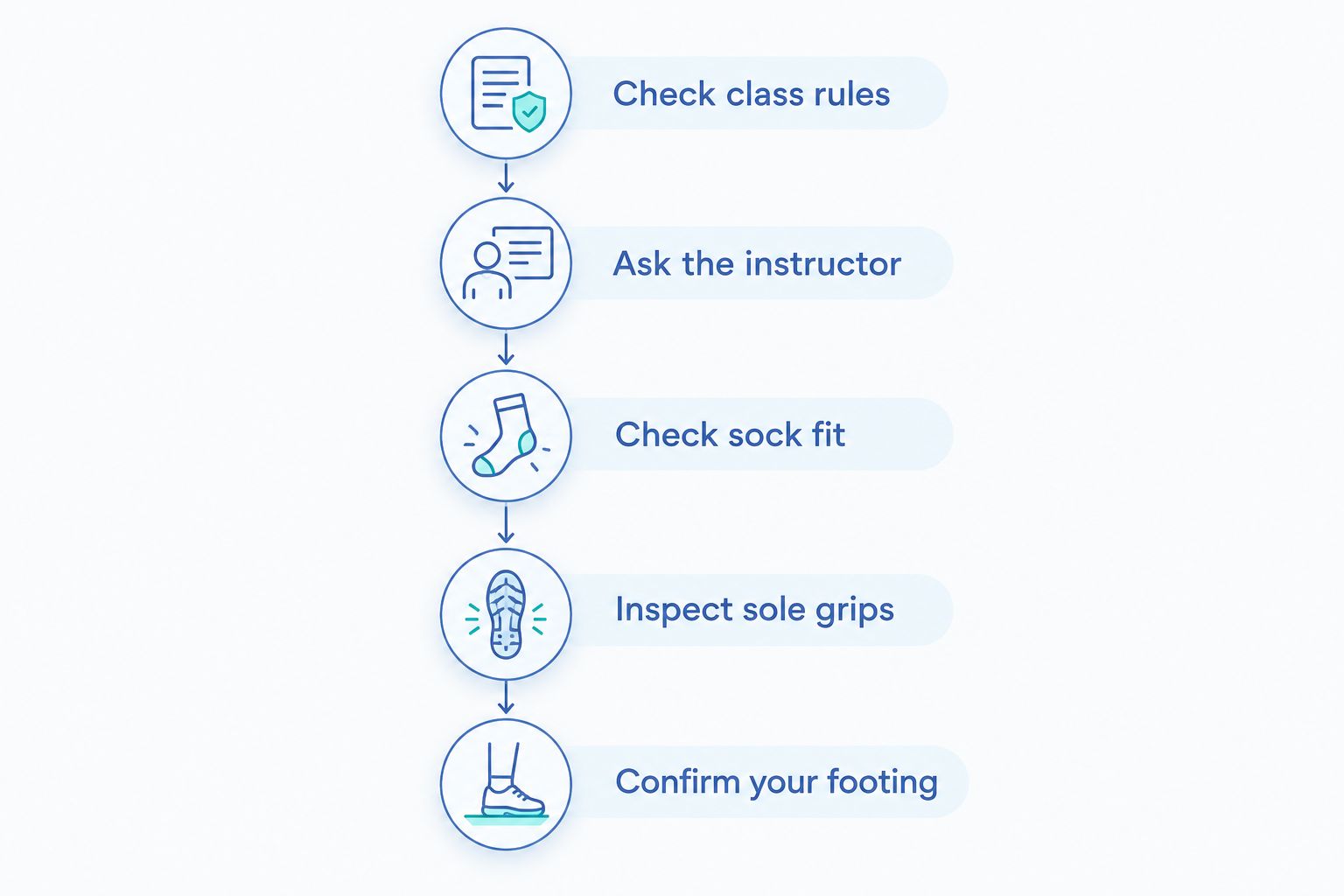
Make this your 2026 pre-class routine. It works whether you are booking your first session or trying a different studio.
- Check class rules. Read the booking confirmation and class description. Look for an explicit footwear instruction rather than assuming that any socks count.
- Ask the instructor. If the wording is unclear, ask whether regular socks are accepted for that specific session. Include whether it is a mat or reformer class.
- Check sock fit. Put on the pair and look for a seated heel, comfortable toes, and fabric that stays aligned. Do not fold excess material underneath your foot.
- Inspect sole grips. If grip socks are required, confirm that the pair actually has grips and that they are intact. Follow the care instructions for cleaning.
- Confirm your footing. Before starting an exercise, tell the instructor about any sliding or twisting. Let the instructor guide the check on the relevant surface.
If you forget the required pair, ask the studio what to do before class begins. Do not assume you can switch to bare feet or that the studio will provide another pair. Get an answer before stepping onto the equipment.
Avoid improvising a fix with folded cuffs, doubled socks, or homemade sole treatments. A footwear problem belongs in the conversation with your instructor, not in a rushed experiment before the warm-up.
Choosing a cute pair without skipping the practical check
Once you know grip socks are appropriate, you can choose the look you actually want to wear. California Grip Socks is best for Pilates practitioners who want cute grip socks designed for studio and everyday wear. That is a style-and-use recommendation, not a claim that one design provides more traction than another.
The California Grip Socks descriptions below give you a real visual distinction: a butterfly design or a ruffled shortie. Choose the look you like, then check the sizing information before ordering.
| California Grip Socks option | Best for | Stated design details | Selection limit |
|---|---|---|---|
| The Butterfly Grip Socks | A butterfly motif with matching grips | Creamy brown socks, beige butterflies, and beige sticky grips | The description does not establish stronger grip than the other option |
| The Ruffle Shortie Grip Socks- Sage | A ruffled shortie look | Lightweight ribbed weave, ruffled top trim, and matching sage grips | Choose only if the available sizing fits you; the trim does not determine traction |
Neither design replaces the class rules or a fit check. California Grip Socks offers playful choices for Pilates, Lagree, yoga, and barre practitioners, but your instructor still decides what belongs in the session.


Can I wear regular socks to mat Pilates?
Regular socks are an option for mat Pilates only when the class allows them and the instructor approves their use. A mat does not remove every traction concern, especially when an exercise includes standing or a change in foot position.
Check the whole session, not just its opening exercises. Starting on your back does not tell you what footwear will suit the movements that follow.
Do I need grip socks for reformer Pilates?
You need grip socks for reformer Pilates when the studio requires them. Regular socks do not satisfy that rule, even if you have worn them successfully in another class.
For a reformer booking in 2026, confirm the footwear instructions before arrival. Once there, ask the instructor about fit and contact rather than testing unfamiliar equipment on your own.
What if I only have regular socks with me?
Tell the instructor before class starts that you brought regular socks. The studio can explain whether those socks are accepted or whether you need to change your plan.
Do not quietly join a grip-socks-required session and hope nobody notices. The quickest route to a clear answer is a direct question at check-in.
FAQ
Can you wear regular socks to Pilates in 2026?
You can wear regular socks to Pilates in 2026 when your studio permits them and your instructor considers them suitable for the exercises. They do not replace grip socks when sole grips are required.
Are regular socks the same as Pilates grip socks?
No, regular socks and Pilates grip socks have different sole surfaces. Grip socks add grippy material underneath the foot, while plain fabric socks do not provide that added surface.
Can I do Pilates barefoot instead of wearing socks?
You can do Pilates barefoot only when the studio and instructor allow it. Bare feet do not meet a policy that requires socks or grip socks.
Will grip socks stop me from slipping completely?
No, grip socks do not guarantee that you will never slip. Fit, sole condition, the contact surface, and the exercise still matter, so report any sliding to your instructor.
Can I wear thick everyday socks to a reformer class?
Thick everyday socks are acceptable only if the class permits them and the instructor approves their use. Thickness does not turn a smooth sole into a grip sole or satisfy a grip-sock requirement.
Can I wear California Grip Socks to Pilates?
California Grip Socks sells grip socks designed for Pilates practitioners. Confirm your studio's footwear rules and choose a pair that fits securely before using it in class.
What should I do if my socks twist during Pilates?
Stop the exercise and tell your instructor if your socks twist during Pilates. Adjust or change the footwear as instructed rather than continuing with fabric moving underneath your foot.
Should I check sock rules again when booking a new studio?
Yes, check the current footwear instructions whenever you book a new studio. For your 2026 bookings, use the class confirmation rather than assuming another studio's rules apply.
One last thing
A sock can grip the surface while your foot still moves inside it. That is why checking the underside is only part of the job. The heel, toes, and fabric alignment deserve attention, too.
Before your next class, ask one clear question: does this session require grip socks? Then bring a permitted pair that fits. Outfit sorted. One less thing to think about when the movement starts.