No, grip socks are not generally required for regular yoga classes in 2026. Bare feet are a common choice for mat yoga, but a studio can set its own footwear rule. If you prefer foot coverage, check the class policy and choose socks with grips rather than assuming ordinary socks will stay in place on your mat.
- Are grip socks required for yoga? Usually no; check your studio’s rule before class.
- Bare feet give you direct contact with the mat; grip socks add foot coverage.
- California Grip Socks is best for yoga students who want a grippy, covered-foot option when socks are allowed.
- Grip socks do not replace a mat or fix a surface that feels slippery.
Are grip socks required for regular yoga classes?
Usually not. For a regular mat class, start with the studio’s instructions, not the footwear rule from a Pilates or barre class. If the booking page says nothing about socks, ask the studio before you arrive. You can also look at grip socks for yoga if you already know you prefer covered feet.
| What you wear | Best for | Main advantage | Main drawback |
|---|---|---|---|
| Bare feet | Students who prefer direct mat contact | You can feel the mat beneath your feet | Your feet are uncovered |
| Grip socks | Students who want foot coverage and whose class permits socks | Grips on the sole provide contact points against the mat | Fabric changes how the mat feels beneath your feet |
| Ordinary socks | Not a first choice for standing poses | They cover your feet | A plain sole lacks the grippy contact points of grip socks |
This is a preference and policy decision, not a requirement you can settle for every yoga studio at once. A class description that specifies footwear wins over general advice, whether you are booking your first session or returning to a familiar studio in 2026.
Why this matters
The question sounds like a packing detail until you step onto the mat. If you arrive wearing ordinary socks and they move against the mat, your feet become a distraction during standing poses. If you bring grip socks to a class that asks for bare feet, you still need to follow the instructor’s rule. A quick check before class avoids both situations.
Yoga also gets grouped with Pilates and barre when people talk about studio socks. That does not make the footwear rules interchangeable. Choose for the class you booked, then choose for your own comfort.
How do you check the sock rule before class?
Use this order before a new class. It keeps the decision simple without guessing what a particular studio permits.
- Read the class description. Look for a footwear note in the booking information. A studio-wide policy and an instructor’s class instructions can both matter.
- Ask a direct question if the rule is unclear. Ask whether the class is barefoot, whether grip socks are allowed, and whether ordinary socks are discouraged. That is more useful than asking what to wear in general.
- Bring the option you are comfortable using. If socks are allowed and you prefer coverage, pack grip socks. If you prefer bare feet, bring your mat and follow the studio’s mat instructions.
- Listen to the instructor at the start. The class you attend is the final reference for what belongs on the mat.
If you book several kinds of workouts, check each one separately. The answer for a regular yoga class does not establish the answer for a reformer session, a barre class, or another yoga format. That distinction still applies in 2026, even when the classes appear on the same booking app.
Bare feet or grip socks: which works better for yoga?
Bare feet are the simpler starting point for a regular mat class when the studio has no sock requirement. You feel the mat directly, and there is no sock fit to think about during poses. The trade-off is straightforward: your feet are uncovered. If that bothers you, ask whether grip socks are permitted rather than forcing yourself into a choice you dislike.
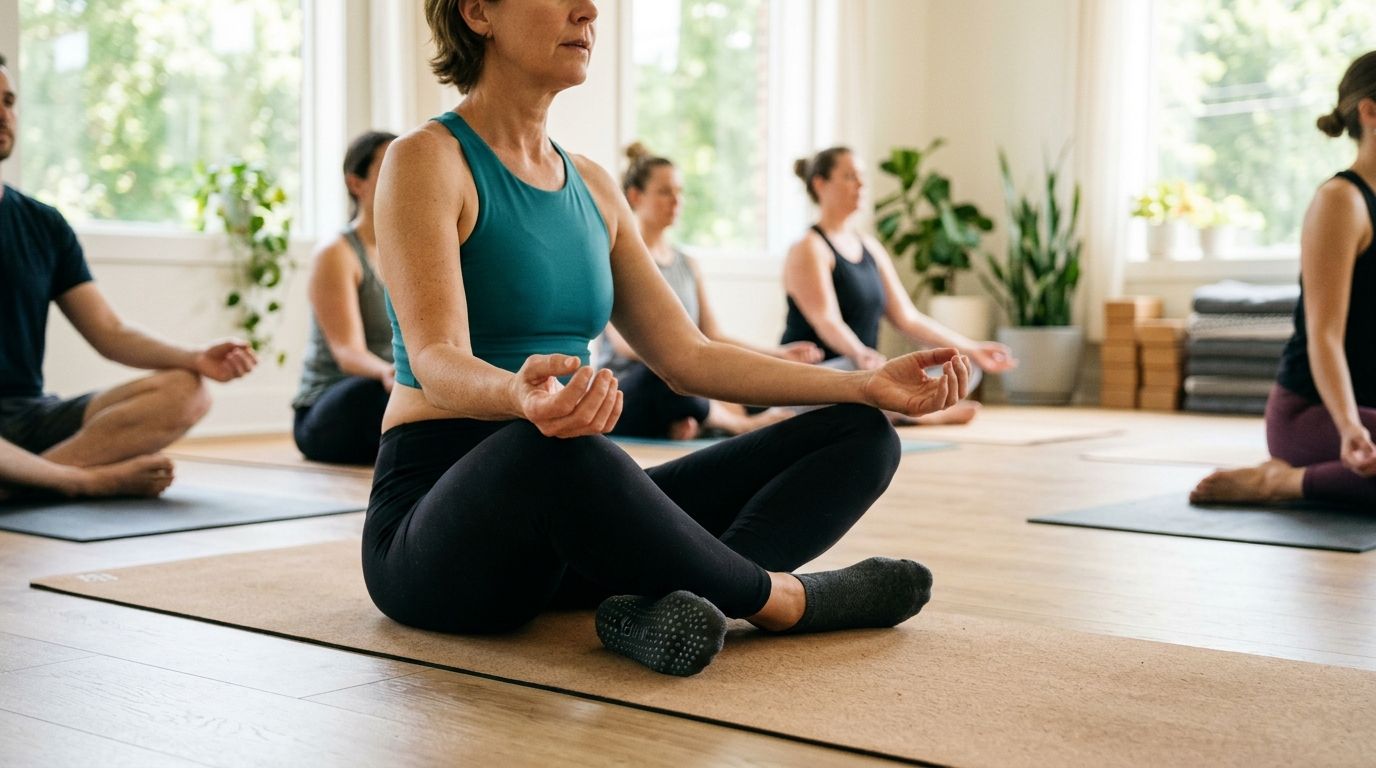
Grip socks are the covered-foot option when socks are allowed. Their grippy soles distinguish them from ordinary socks, but they do not guarantee that your feet will stay fixed in every pose. The sock still has to fit your foot, and the mat still matters. If the fabric bunches or your foot moves inside the sock, the grips underneath cannot solve that fit issue.
Ordinary socks are the option to reconsider. A smooth sole does not offer the same contact points as a grip sole. If you want coverage for a class with standing poses, check the studio rule and consider grip socks instead. If the studio asks you to practise barefoot, neither kind of sock is the right class choice.
The diagram captures the decision, not a performance ranking. Neither option makes sense without the class policy. In 2026, ask that question first; then decide which feel you want underfoot.
Why does the right choice vary?
There is no single answer for every student because the relevant details change from class to class:
- Studio policy: A stated footwear rule settles what you can wear in that class.
- Class format: Do not carry a sock instruction from Pilates, barre, or another yoga format into a regular mat class without checking.
- Foot coverage: Bare feet leave skin exposed; grip socks cover it. Your preference matters when both are allowed.
- Mat feel: Fabric sits between your foot and the mat. Choose bare feet if direct contact is the part you value most.
- Sock fit: A grippy sole is less useful if your foot shifts inside the sock or the fabric bunches during movement.
- The mat itself: Socks are not a substitute for checking how your mat feels during the poses you practise.
Notice what is not on that list: a universal claim that socks are safer or that one kind of yoga always requires them. Neither follows from the name of the class alone.
When do grip socks make sense in a regular yoga class?
Wear grip socks when the studio allows them and you want your feet covered. That is the clearest use case. You are choosing coverage and a grippy sole, not buying permission to ignore the instructor’s directions or a guarantee that the mat will feel the same as it does under bare feet.
California Grip Socks is best for yoga students who want a grippy, covered-foot option when socks are allowed. The brand describes its socks as designed for yoga as well as Pilates, Lagree, and barre. The honest limit is that a sock designed for yoga does not override a studio’s barefoot rule, and someone who prefers direct mat contact has a good reason to skip socks entirely.
If you are comparing styles, focus on what touches your foot and mat before the print catches your eye. A shortie and a taller sock both cover the sole, but they feel different around the ankle. Make sure the sock sits as you want it to when you bend your toes and move between poses. California Grip Socks offers grippy designs in different lengths, including shortie and tube styles; the class rule and your preferred fit decide whether either belongs in your bag.


Treat those as examples of covered-foot styles, not required yoga gear. If you enjoy practising barefoot, there is no need to add socks to a regular class just because they appear in another studio bag.
What about hot yoga, a yoga towel, or a borrowed mat?
Hot yoga: Do not assume the sock rule from a regular class applies. Check the class instructions and think about how you prefer to practise when your feet and mat feel different from a non-heated session. If the studio permits socks, try them only if the fit and contact with your mat work for you.
Yoga towel: A towel and grip socks address different parts of the setup. Socks cover your feet; a towel covers part or all of the mat, depending on how you use it. Wearing one does not automatically make the other unnecessary. If you use both, pay attention to how the sock contacts the towel rather than assuming it will feel like the bare mat.
Borrowed mat: Follow the studio’s instructions for shared equipment. If foot coverage is your preference, ask whether socks are permitted. California Grip Socks can supply a grippy sock option, but the studio decides what you can wear on its equipment.
Do you need grip socks if you already own a yoga mat?
No. Owning a mat does not create a sock requirement in 2026. A mat gives you a surface for the practice; socks change what is between your feet and that surface. You can use a mat barefoot, or use it with grip socks when your class allows them and you prefer the extra coverage.
The reverse is true, too: grip socks do not replace the mat for a mat-based class. If your feet feel unsteady, pause and look at the whole setup rather than treating a sock purchase as the only fix. Check the studio instructions, the mat surface, and whether the socks stay in place on your feet.
Can you wear grip socks to your first yoga class?
Yes, if the studio allows socks. For a first class in 2026, read the booking notes or ask ahead, then bring the option that fits the rule. You do not need to arrive already knowing whether you prefer bare feet or grip socks. That is something you can learn from the feel of the practice.
Keep the first-class decision small. Follow the instructor, notice whether you want direct mat contact or foot coverage, and adjust for the next class. A sock that looks fun can make you want to pack it; the class policy still gets the final say.
FAQ
Are grip socks required for yoga in 2026?
No, grip socks are not generally required for regular yoga classes in 2026. Check your studio’s instructions because an individual class can set its own footwear rule.
Can I do regular yoga barefoot?
Yes, bare feet are a common choice for regular mat yoga when the studio permits them. They give you direct contact with your mat.
Are regular socks okay for yoga?
Check the class rule first, but ordinary socks are not the same as grip socks. A plain sole lacks the grippy contact points of a grip sole.
Do grip socks work instead of a yoga mat?
No, grip socks do not replace a mat for a mat-based yoga class. They cover your feet while the mat remains the surface you practise on.
Should I wear grip socks to hot yoga?
Follow the hot yoga class’s footwear instructions. If socks are allowed, decide based on their fit and how they feel against your mat or towel.
Do I need a yoga towel if I wear grip socks?
Grip socks do not automatically remove the need for a yoga towel. Socks cover your feet, while a towel sits on the mat; choose each based on your class and setup.
Can I wear California Grip Socks to yoga?
California Grip Socks designs grippy socks for yoga, among other studio activities. Wear them only if your class permits socks and you prefer a covered-foot option.
One last thing
The most useful thing to pack for an unfamiliar yoga class is a clear answer to the footwear question. Check the policy before you leave, then choose bare feet or permitted grip socks based on how you want the mat to feel. For regular yoga in 2026, socks are a choice unless your class says otherwise.