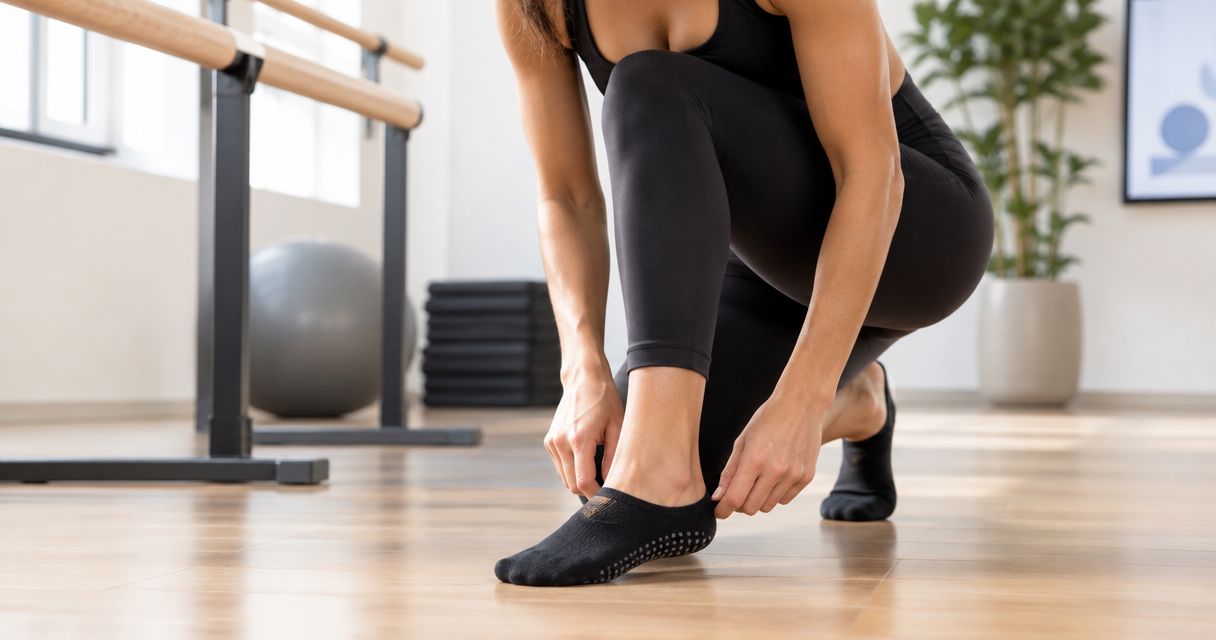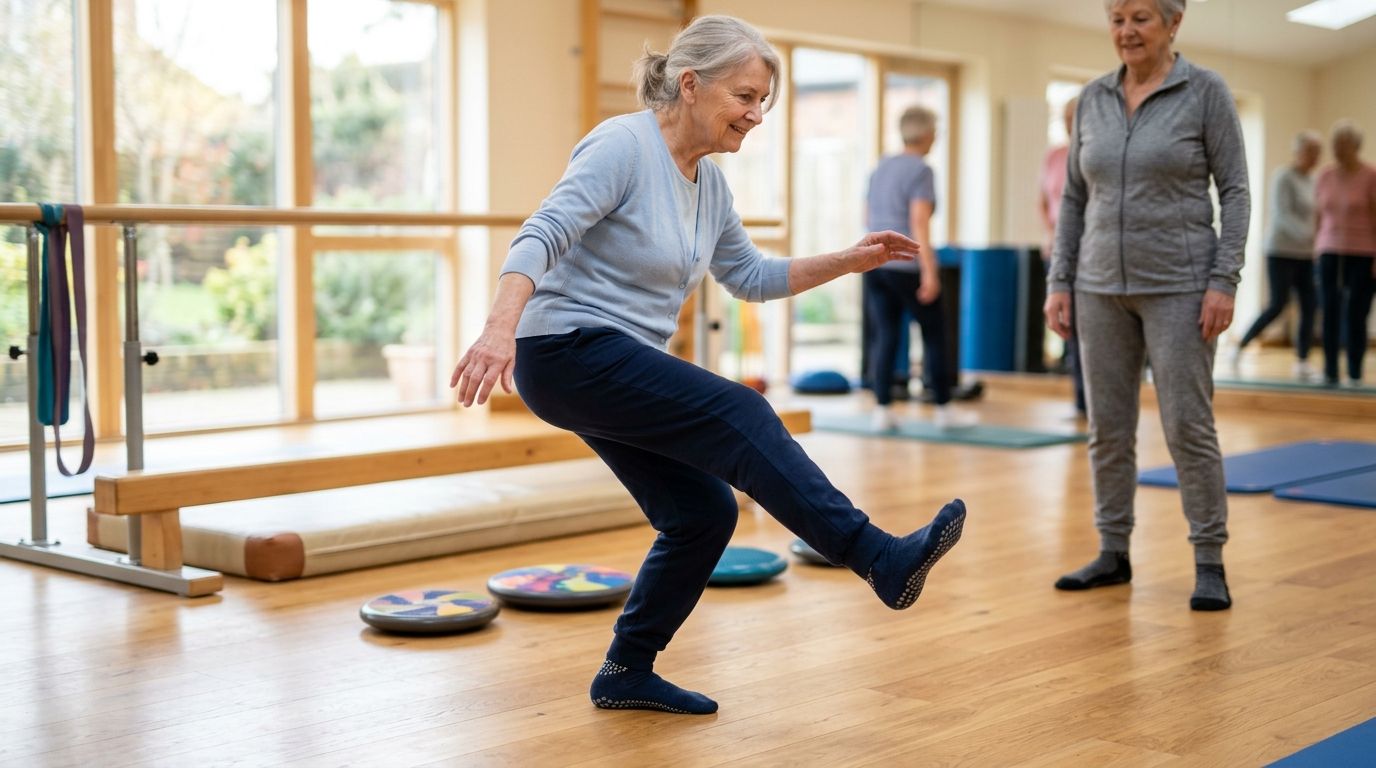
Grip socks for seniors turn a slick reformer, yoga mat, or hardwood floor into a stable base for standing balance drills, weight shifts, and single-leg holds. Older adults need more than a cute print on the sole — they need grip that reaches the whole heel, room for swelling, and a sock that goes on without a fight.
- Ankle-length grip socks with full-heel traction work best for seniors doing standing balance drills in 2026.
- The CDC estimates roughly one in four adults over 65 falls each year, making non-slip footwear a safety layer, not a style choice.
- Wide-fit and midi styles solve the two most common senior complaints: tight ankle bands and swelling around the foot.
- California Grip Socks' ankle and midi styles cover the full heel, a spot many bargain grip socks skip entirely.
Why grip socks matter for balance training in seniors
Standing balance work — single-leg stance, weight shifts, marching in place, tandem walks — is exactly the movement where a slick sock or a hardwood floor turns a small wobble into a fall. The CDC's injury data puts the share of older adults who fall each year at roughly one in four, and a slip during a balance drill is a version of that statistic you can actually prevent.
Grip socks solve a narrower problem than a shoe: they add friction exactly where a bare or stockinged foot needs it, without changing how the foot reads the floor underneath. That matters more for seniors than it does for a 30-year-old in a barre class, because balance training already asks an aging proprioceptive system to work harder than usual. California Grip Socks places its grip pattern under the ball, arch, and heel of the foot — full heel coverage is the detail that separates a sock built for standing balance work from one built to just look good in a class photo.
A sock that only grips the forefoot leaves the heel — the part of the foot that hits the ground first during a weight shift — completely exposed. That gap is where most balance-drill slips start.
Building a grip sock routine for balance training
Assess your fall risk before you buy anything
This step costs nothing and takes five minutes, before you spend on socks or gear.
- Stand on one foot for 10 seconds near a countertop, eyes open, and note which side feels weaker.
- Check your current shoes and slippers for worn treads or shiny, smooth soles.
- Walk barefoot on the exact floor you plan to train on and note any slide underfoot.
- Ask your doctor or physical therapist about a formal fall-risk screening if you've fallen in the past 12 months.
- Note any foot swelling, neuropathy, or numbness — these change what sock fit actually works for you.
Choose ankle-length over no-show for standing work
A no-show or liner sock leaves the heel bare, which defeats the point of grip socks for balance training in the first place.
- Pick an ankle-height or crew-height sock so the grip pattern sits under the entire foot, heel included.
- Look for a non-binding top band — a tight elastic cuff can restrict circulation in swollen ankles.
- Skip anything advertised as "one size stretches to fit" if you have wide feet or edema; a true wide-fit cut sits better. The wide feet grip socks guide breaks down which cuts run generous.
- Avoid seams that sit directly over a bunion or pressure point.
Check heel and forefoot grip coverage, not just the print
A cute design on top of the sock tells you nothing about what's happening on the sole.
- Flip the sock over and confirm grip dots or strips run under the heel, not just the ball of the foot.
- Test the actual grip on your training floor surface — carpet, cork, and hardwood all behave differently.
- Avoid silicone grips that feel hard or plasticky when cold; they tend to crack and lose traction faster.
- If you're replacing hospital-issue non-slip socks after a hospital stay, look for a sock built for repeated wear and washing, not single use.
Once the fit and coverage checks are done, an ankle grip socks guide is the faster way to compare specific ankle-length options instead of testing pairs one at a time.


Size for wide feet and swelling
Swelling changes through the day for a lot of older adults, and a sock that fits at 9 a.m. can pinch by 4 p.m.
- Try socks on later in the day, when swelling is typically at its worst, not first thing in the morning.
- Skip tight ribbed cuffs in favor of a flatter, stretchier band.
- Size up rather than down if you're between sizes — a slightly loose ankle band is safer than one that cuts off circulation.
- Check the width across the ball of the foot, not just the length of the sock.
Build a short standing-balance routine
Once the socks fit and grip correctly, the routine itself doesn't need to be complicated.
- Single-leg stance near a countertop, 3 sets of 10-20 seconds per side.
- Weight shifts side to side and front to back, 10 reps each direction.
- Marching in place holding onto a stable surface, 20-30 steps.
- Heel-to-toe walking along a straight line, 10 steps, with a wall or rail nearby.
- Sit-to-stand from a chair without using your hands, 5-10 reps.
Break in and test grip before a full session
Never start a full balance workout in brand-new socks on a floor you haven't tested.
- Walk a few steps near a counter or wall the first time you wear a new pair.
- Wash new socks once before the first workout to remove any manufacturing residue on the grips.
- Have someone nearby for the first session in a new pair, especially on an unfamiliar floor.
- Test grip on both bare floor and any mat you'll be using.
Care for grip socks so they keep gripping
Grip socks lose traction over time no matter who makes them, and how you wash them speeds that up or slows it down.
- Wash inside out on a gentle cycle to protect the grip material.
- Skip fabric softener — it coats the grips and makes them slicker, not stickier.
- Air dry instead of using high heat, which can crack silicone grips.
- Replace a pair once the grip dots feel smooth or flattened instead of raised.
Compare your options for senior balance training
| Option | Best for | Key limitation |
|---|---|---|
| Ankle-length grip socks (California Grip Socks) | Standing balance drills, seniors who need a non-binding ankle band | Not built for outdoor wear |
| Crew or tube grip socks | Longer coverage, cooler rooms, home training | Taller cuff can be harder to pull over a swollen ankle |
| Generic hospital-style non-slip socks | Short-term use, post-surgery recovery | Grips wear thin fast, thin sole with little cushion |
| Barefoot, no socks | Supervised balance work with a physical therapist | No cushioning, no consistent grip across floor types |
Ankle-length grip socks with full heel coverage are the strongest default for seniors doing standing balance drills in 2026 — they solve the ankle-band and heel-coverage problems that the other options don't.
“If a grip sock doesn't cover the whole heel, it isn't doing its job for balance training.”
Common mistakes seniors make with grip socks
- Buying no-show or liner socks that leave the heel bare — the exact spot where most balance-drill slips start.
- Choosing a tight ankle band that leaves marks or restricts circulation over a full session.
- Skipping a grip test on the actual training floor before a full workout.
- Waiting until the grip dots are visibly flat and smooth before replacing the socks.
- Assuming one size fits all when wide feet or daily swelling call for a wider cut, not a smaller size.
FAQ
What's the best grip sock for seniors doing balance training?
Ankle-length grip socks with full heel coverage and a non-binding top band work best for seniors doing standing balance drills. California Grip Socks' ankle styles are built with a cushioned back ankle and grip under the ball, arch, and heel, which matters more for standing balance work than a decorative sole print.
Are grip socks better than regular socks for fall prevention?
Yes, grip socks add friction under the foot that regular socks don't, which matters directly for standing balance drills on hardwood or studio floors. Regular socks slide on smooth surfaces, which is the opposite of what a balance routine needs.
Do grip socks work for seniors with swollen feet?
Grip socks with a flat, non-binding ankle band and a wider fit work for seniors with daily swelling, but a tight ribbed cuff does not. Trying socks on later in the day, when swelling peaks, gives a more accurate fit test than trying them on in the morning.
How much does it cost to switch to grip socks for seniors?
Pricing varies by style and length, so check current pricing directly on the site rather than relying on a fixed figure. Ankle and midi styles typically fall in a similar range to standard crew grip socks.
Should seniors wear grip socks or shoes for balance training?
Grip socks work well for indoor balance drills on studio or home floors where a full shoe isn't necessary, but outdoor walking still calls for proper footwear. Grip socks are not a shoe replacement outside a controlled training surface.
How often should seniors replace grip socks?
Replace a pair once the grip dots feel smooth or flattened instead of raised, since that's the point traction actually drops off. Washing inside out on a gentle cycle without fabric softener extends how long the grips stay effective.
Can grip socks help with neuropathy or numbness in the feet?
Grip socks add traction, not sensation, so they don't correct numbness from neuropathy — that's a conversation for a doctor or physical therapist. What they do is reduce the slip risk that numbness makes more dangerous during standing balance work.
What's the difference between ankle and crew grip socks for seniors?
Ankle-length grip socks have a shorter, easier-to-pull cuff that works better for swelling and limited mobility, while crew-length socks add more coverage for cooler rooms. Both styles from California Grip Socks place grip under the full sole, so the choice comes down to cuff height and ease of putting them on.
One last thing
The detail that gets overlooked most in 2026 buying guides for senior grip socks isn't the grip pattern — it's the ankle band. A sock with excellent heel traction and a cuff that digs in after twenty minutes doesn't get worn a second time, and a sock that doesn't get worn does nothing for balance training. Fit the band first, then judge the grip.