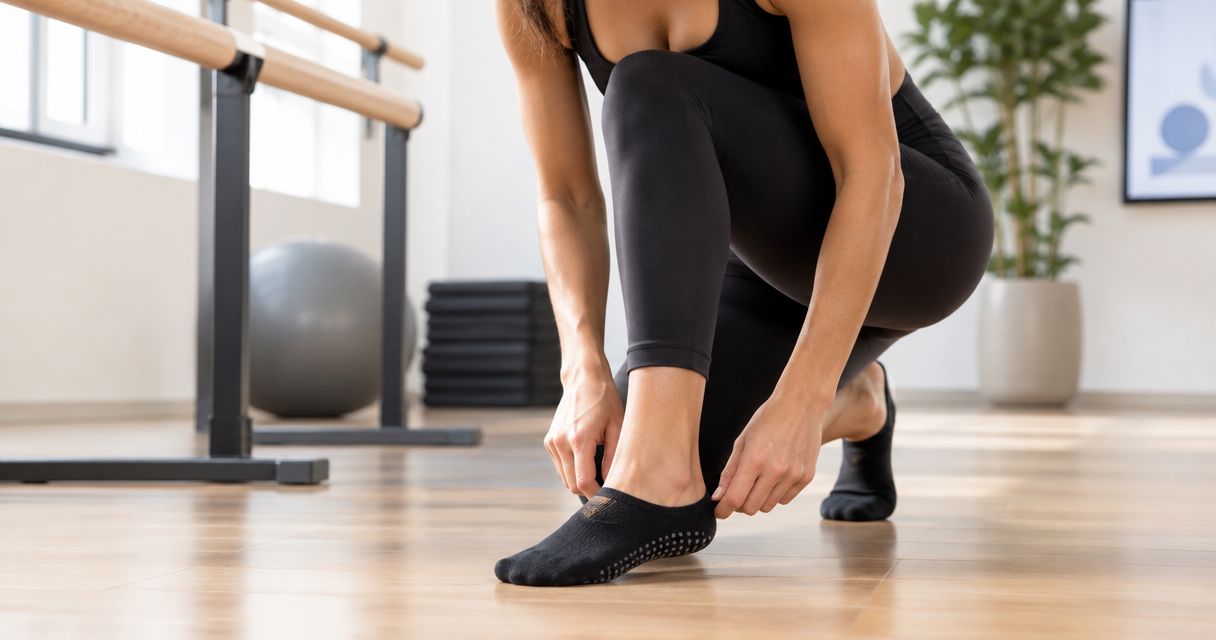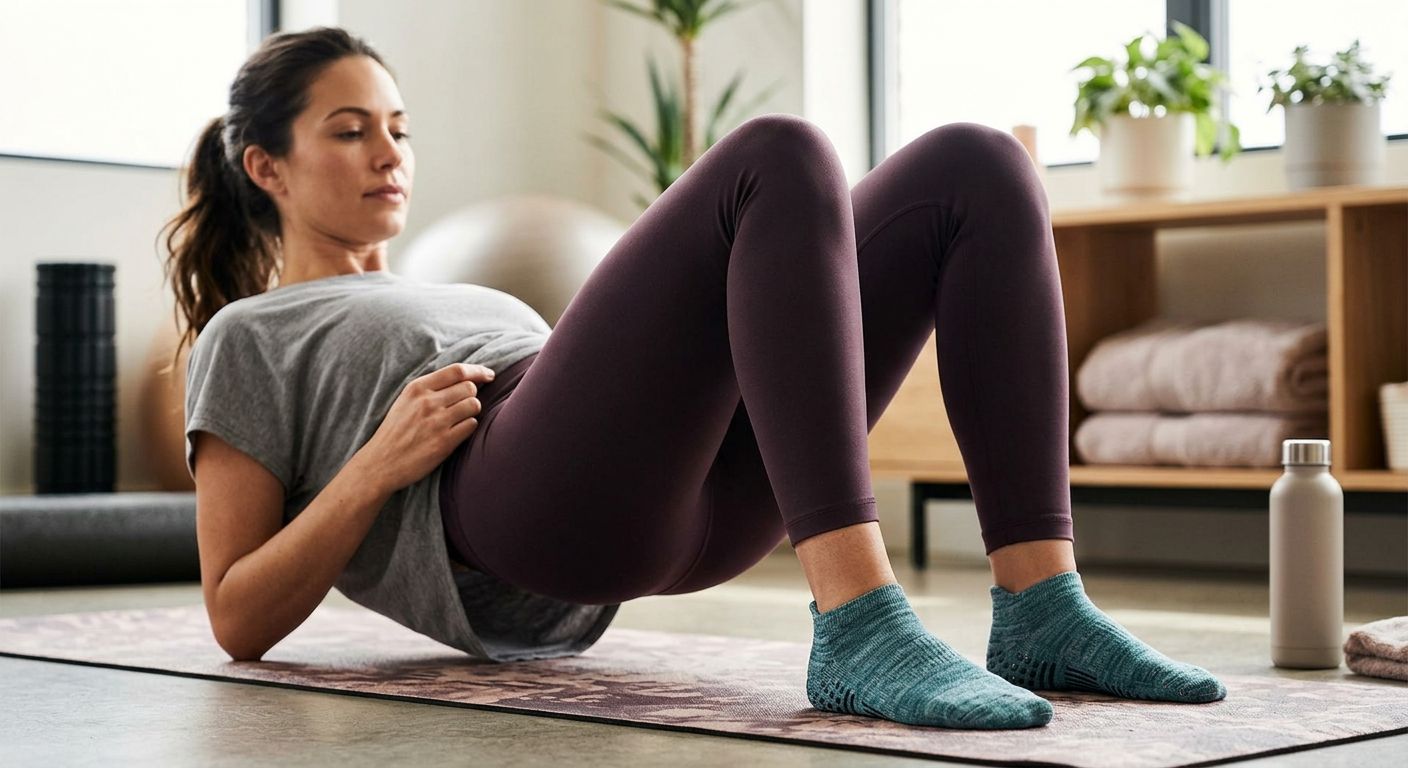
Grip socks for postpartum workouts are non-slip socks with silicone tread on the sole, worn to Pilates, barre, and yoga classes to keep you stable on a reformer, mat, or studio floor while your feet, balance, and core are still recovering. The postpartum body doesn't move like the pre-pregnancy body — feet can swell or shift a half size, balance is different once the pelvic floor and core are rebuilding strength, and standing time in class might be shorter than it used to be. A sock built for a pre-baby Pilates routine doesn't automatically fit those changes.
- Grip socks for postpartum workouts need extra room, soft seams, and reliable grip for a body still rebuilding balance in 2026.
- Size up half a size if swelling hasn't fully resolved — a tight sock leaves marks and dulls sensation on the sole.
- Ankle and midi lengths from California Grip Socks accommodate swelling better than a compression-style sock.
- Skip single-leg reformer work until balance feels steady again — grip helps, it doesn't replace core control.
Why grip socks matter for postpartum recovery workouts
Most grip sock content is written for the general Pilates crowd. Postpartum bodies have different constraints: fluid retention can make feet genuinely bigger for weeks after delivery, C-section healing and stretched abdominal muscles change how you balance on one foot, and a lot of new parents are returning to studio classes after months off the reformer or the mat.
The sock has to accommodate a foot that might not be its usual size, grip well enough to compensate for a wobblier center of gravity, and go on easily when bending over still isn't comfortable. If you're shopping specifically for this stage, start with a guide built for a changing body: grip socks for prenatal Pilates covers sizing and grip placement during pregnancy, and most of that logic carries straight into the postpartum months of 2026.
Update your sizing first
Postpartum feet aren't always the same feet you had in 2025. Pregnancy hormones loosen ligaments and fluid retention adds swelling that can linger for weeks after delivery — and for some people the change sticks around permanently.
- Measure both feet in the afternoon, when swelling peaks, not first thing in the morning.
- Size up if your usual sock leaves a red line at the ankle or arch after class.
- Avoid compression-style grip socks in the first 6-8 weeks if you're still swelling.
- Try a midi or crew length before a snug ankle-band style — less elastic pressure at the ankle.
- If sizing is genuinely uncertain, buy two lengths and keep the one that doesn't leave marks.
Check the grip pattern against your class type
Not every studio surface needs the same tread. A reformer carriage, a Lagree megaformer, and a mat floor all put pressure on different parts of the foot.
- Reformer and Lagree classes need grip concentrated at the ball and heel, where the carriage contacts the sock.
- Mat-based barre and yoga need grip across the whole sole for floor transitions.
- Silicone dot grips hold better on slick studio floors than thin painted prints — the best silicone grip socks guide breaks down tread types.
- Replace socks once the silicone feels smooth to the touch, not when the fabric looks worn.
Prioritize soft seams and low compression
A healing incision, stretched abdominal skin, or general postpartum sensitivity makes seam placement matter more than it did before.
- Look for a flat toe seam instead of a bulky one that rubs against a mat or inside a shoe.
- Avoid tight elastic bands sitting directly over swollen ankle skin.
- Ribbed, stretchy knits handle fluctuating foot size better than a rigid weave.
- Cotton-blend socks breathe better through postpartum temperature swings.
- If a sock leaves indentation marks after 10 minutes, it's too tight — size up or change lengths.
Build a rotation instead of relying on one pair
Postpartum recovery workouts are inconsistent by nature — some weeks you make three classes, some weeks none. A rotation solves the laundry problem before it becomes a reason to skip class.
- Keep at least 3 pairs in rotation so one is always clean.
- Wash grip-side out to protect the silicone tread.
- Skip fabric softener — it coats the grips and cuts traction within a few washes.
- Air dry when you can; high heat breaks down silicone faster than normal wear does.
- A Pilates grip sock built for studio wash-and-repeat use holds tread longer than a generic athletic sock repurposed for class.
Match ankle height to your recovery stage
Swelling doesn't resolve on a fixed schedule, and ankle height changes how much pressure sits on it.
- Ankle-length socks put a band right at the swelling point — fine once swelling has mostly resolved.
- Midi and crew lengths distribute pressure higher up the calf, away from the most swollen area.
- Still swelling past 6 weeks? Favor a looser midi over a snug ankle cut.
- Grip socks for wide feet suit anyone whose foot width changed after pregnancy, not just people who were wide-footed before.
Test balance before you push intensity
Pelvic floor and core changes shift your center of gravity even after strength starts returning. Grip keeps you planted. It does not give you control.
- Start with two-foot balance work before single-leg reformer moves.
- Hold the wall or barre for your first few single-leg exercises back.
- Watch for your foot sliding inside the sock — that's a fit problem, not a grip problem.
- Progress to unassisted single-leg work once you can hold it 20-30 seconds without wobble.
- If balance still feels off after 8-10 sessions, raise it with a pelvic floor physical therapist rather than pushing through.
Style them so class still feels like yours
Postpartum life is functional enough already. California Grip Socks makes prints and colorways that don't read as medical wear, which matters when class might be the one hour of the week that's yours.
- Pick a print you'd wear walking out of the studio, not just inside it.
- Midi lengths in soft colors pair with leggings without looking clinical.
- Matching sets make packing a class bag faster on already-tight mornings.
- Crew grip socks cover the longest lengths if you want more leg coverage in cooler months.


Comparing your options for postpartum workouts
| Option | Best for | Key limitation | Verdict |
|---|---|---|---|
| Bare feet | People who prefer no fabric at all | No traction and no barrier between sensitive skin and equipment | Skip for reformer and Lagree |
| Generic no-slip socks | Occasional at-home movement | Tread isn't placed for reformer or barre contact points | Hold as a backup only |
| Standard ankle grip socks | Feet back to pre-pregnancy size | Snug band sits right on lingering swelling | Wait until swelling resolves |
| Midi-length grip socks, sized up | Active swelling and fluctuating foot size | Slightly more fabric to manage inside tight shoes | Buy — best fit for the recovery window |
Common mistakes postpartum clients make with grip socks
- Buying the pre-pregnancy size out of habit. A sock that fit in 2025 can leave marks in 2026 if swelling hasn't fully gone.
- Jumping straight back to single-leg reformer work. Grip adds traction; core and pelvic floor control take longer to come back than the socks do.
- Ignoring seam placement near a healing scar. A bulky seam rubbing through a 50-minute class isn't something to tolerate.
- Wearing one worn-out pair. Flattened silicone loses traction well before the knit looks used.
- Assuming any grip sock fits any class. Reformer tread and mat tread solve different problems — check the guide for your studio type first.
FAQ
What's the best grip sock for postpartum Pilates in 2026?
A midi-length grip sock sized up half a size suits most postpartum bodies in 2026, because it avoids a snug band sitting on lingering ankle swelling. Ankle lengths work well once swelling has fully resolved.
Do I need bigger grip socks after having a baby?
Often yes, at least temporarily, because fluid retention and pregnancy-related ligament looseness can make feet measure larger for weeks after delivery. Measure in the afternoon when swelling peaks rather than in the morning.
Is it safe to do Pilates with grip socks right after giving birth?
Grip socks are safe whenever you're cleared for movement, but your return-to-Pilates timeline depends on your delivery and recovery, not the socks. Most people ease back in gradually after provider clearance, starting with gentle mat work before reformer classes.
How much do grip socks cost for postpartum workouts?
Pricing varies by length and style, so check the current price on the product page before buying. Ankle, shortie, midi, and full tube styles are priced differently based on how much fabric each uses.
Are ankle or crew grip socks better for swollen postpartum feet?
Crew and midi lengths are generally better for swollen feet because they spread pressure higher up the calf instead of banding at the ankle. Switch to ankle length once swelling has mostly settled.
Can grip socks help with balance problems after pregnancy?
Grip socks improve traction on reformer carriages and studio floors, which reduces slipping during balance-focused moves. They don't replace the core and pelvic floor strength that actually restores balance control.
What grip sock length works best for reformer Pilates postpartum?
A midi length works best for most people, since it keeps elastic pressure off a still-swollen ankle while gripping the carriage at the ball and heel. Add ankle styles back once swelling resolves.
How often should I replace grip socks during postpartum recovery?
Replace them when the silicone tread feels smooth to the touch, which usually happens before the fabric wears out. Keeping 3 pairs in rotation makes the wear easier to spot and spreads it out.
One last thing
Foot size doesn't always snap back. Pregnancy hormones loosen ligaments throughout the body, including the arch — and for plenty of people that change is permanent, not a temporary swelling issue. So if a sock that fit perfectly in 2025 feels tight in class in 2026, you're not imagining it. Size up, default to midi length, and let the fit follow your recovery instead of forcing the old size to work.